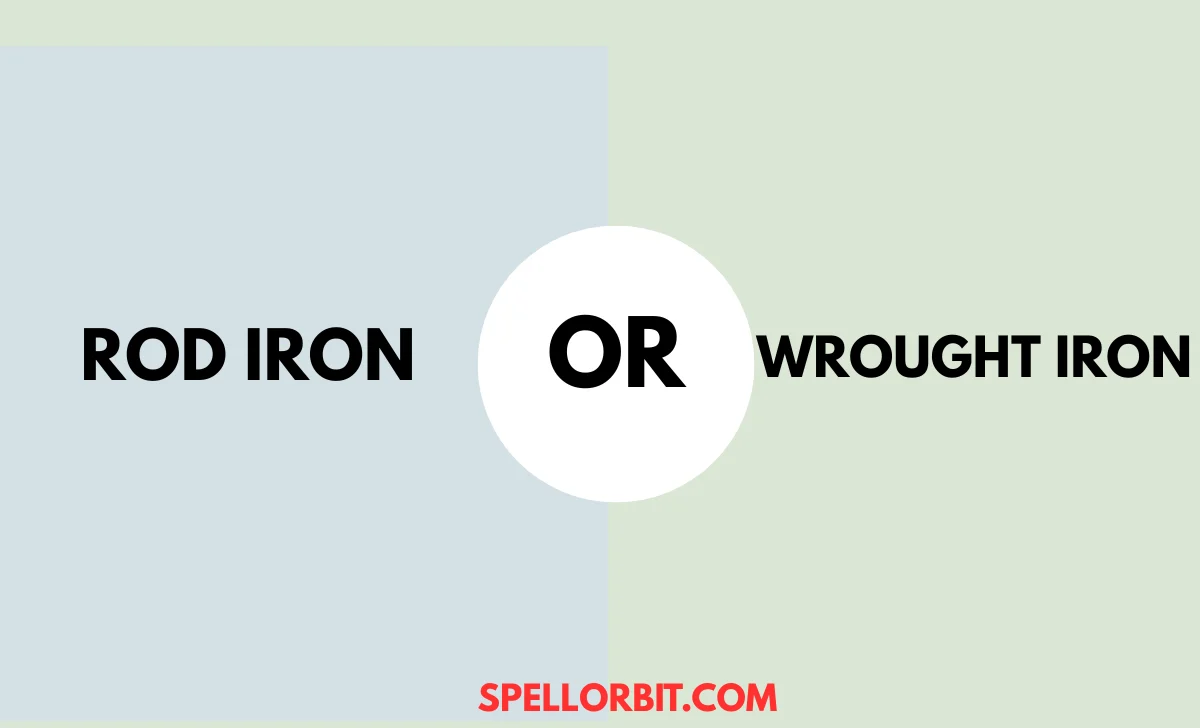
The correct term is wrought iron, not “rod iron,” when you mean iron that has been worked into a shape by heating and hammering.
The confusion happens because “wrought” is pronounced like “rot,” so some people hear the word and spell it as “rod.”
Others may also connect the term with iron rods used in gates, fences, and railings. This makes “rod iron” look logical even though it is not the standard term.
In this guide, you will learn the correct spelling, the history of wrought iron, British and American usage, common mistakes, everyday examples, and simple ways to remember which form to use.
Quick Answer
Wrought iron is the correct spelling.
“Rod iron” is a common misspelling or mistaken form of wrought iron. It is not the standard name for the traditional type of iron.
Wrought iron is iron that has been worked or shaped, usually through heating, hammering, rolling, or other processes. It was widely used for gates, fences, railings, tools, furniture, and decorative objects.
Correct
- The house has a beautiful wrought iron gate.
- We ordered a wrought iron fence.
- The balcony has wrought iron railings.
Incorrect
- The house has a beautiful rod iron gate.
- We ordered a rod iron fence.
The word wrought is important because it comes from an old form of the word “work.” It describes something that has been worked or shaped.
The Origin of Rod Iron or Wrought Iron
The word wrought has a long history in English. It is an old past form of work, and it was used to describe something that had been made, shaped, or worked.
The term wrought iron therefore means iron that has been worked.
Historically, blacksmiths heated iron and then shaped it with tools such as hammers. This process made wrought iron useful for making practical and decorative items.
Wrought iron became especially important before modern steelmaking became widespread. Blacksmiths used it to make:
- Gates
- Fences
- Railings
- Hinges
- Chains
- Tools
- Hardware
- Decorative metalwork
The spelling wrought can be confusing because its pronunciation changed over time. In modern English, “wrought” is commonly pronounced like “rot.” Because the pronunciation does not clearly show the spelling, people sometimes write “rod iron” instead.
However, “rod iron” does not represent the historical name of the material.
British English vs American English Spelling
There is no major British-versus-American spelling difference here.
Both British English and American English use wrought iron.
| Meaning | British English | American English |
|---|---|---|
| Worked iron | wrought iron | wrought iron |
| Incorrect form | rod iron | rod iron |
| Wrought iron gate | Correct | Correct |
| Wrought iron fence | Correct | Correct |
| Wrought iron railing | Correct | Correct |
Unlike words such as colour/color or centre/center, this term does not change between British and American English.
You can therefore use wrought iron in writing for readers in the UK, US, Canada, Australia, and other English-speaking regions.
Examples
British English:
The old garden has a beautiful wrought iron gate.
American English:
The old garden has a beautiful wrought iron gate.
The spelling remains the same.
Which Spelling Should You Use?
Use wrought iron in all standard English writing.
For American English
Use wrought iron in emails, articles, product descriptions, reports, and formal documents.
For British English
Use wrought iron as well. British English does not use a different spelling for this term.
For Professional Writing
Always choose wrought iron when referring to the traditional iron material or objects made from it.
For example:
The property features an original wrought iron staircase.
For Global Audiences
Wrought iron is the safest choice because it is the accepted standard term across major varieties of English.
If you are describing a simple metal rod rather than the material known as wrought iron, use iron rod or metal rod, depending on what you mean.
Common Mistakes with Rod Iron or Wrought Iron
The biggest mistake is writing rod iron instead of wrought iron.
Mistake 1: Rod iron
Incorrect:
The building has a rod iron fence.
Correct:
The building has a wrought iron fence.
Mistake 2: Thinking “wrought” means rod
The word “wrought” does not mean “rod.” It is connected to the idea of working or shaping something.
Mistake 3: Spelling it by sound
Because wrought sounds like “rot,” writers may try to spell the phrase based on pronunciation.
Wrong: rod iron
Right: wrought iron
Mistake 4: Using “wrought” for every iron rod
Not every iron rod is made from wrought iron.
If you simply mean a rod made of iron, iron rod may be more accurate.
For example:
- The worker carried an iron rod.
- The garden has a decorative wrought iron fence.
The two phrases can describe different things.
Mistake 5: Changing wrought to “rought”
Another common spelling error is:
Wrong: rought iron
Correct: wrought iron
The w is silent, but it must still be included.
Rod Iron or Wrought Iron in Everyday Examples
Knowing how the term appears in real writing can make the correct spelling easier to remember.
In an Email
We would like to receive a quote for a new wrought iron gate.
Here, wrought iron describes the material or type of metalwork.
In a News Article
The historic building still has its original wrought iron balcony.
News writing uses the standard spelling because the phrase refers to a recognized type of metalwork.
On Social Media
I love the details on this old wrought iron gate!
Informal writing still uses wrought iron, even when the tone is casual.
In Formal Writing
The restoration project will preserve the building’s original wrought iron railings.
The spelling is appropriate for reports, academic writing, business documents, and historical descriptions.
In a Product Description
This wrought iron garden table combines traditional design with durable construction.
Retailers often use wrought iron when describing furniture, gates, fences, and outdoor decorations.
Rod Iron or Wrought Iron – Google Trends & Usage Data
Search behavior shows why this spelling question exists: people often search for the phrase “rod iron or wrought iron” because they have heard the expression but are unsure how to spell it.
The incorrect form rod iron appears in searches, online listings, social media posts, and informal writing. However, wrought iron is the established term used in dictionaries, historical references, construction language, metalworking, architecture, and professional writing.
Usage also varies by context.
Home and Construction Searches
People often search for terms such as:
- Wrought iron gates
- Wrought iron fences
- Wrought iron railings
- Wrought iron doors
- Wrought iron furniture
Historical Writing
Wrought iron is common when discussing traditional blacksmithing, historic buildings, old gates, and architectural metalwork.
Search Intent
A person searching for rod iron may actually be looking for:
- Wrought iron
- Iron rods
- Iron gates
- Metal fencing
- Decorative ironwork
This is why understanding the meaning matters as much as knowing the spelling.
Google Trends popularity can also change by country, season, and search intent. Search volume should therefore be checked for a specific country and date range when making precise SEO decisions.
Rod Iron vs Wrought Iron: Comparison Table
| Term | Correct? | Meaning | Example |
|---|---|---|---|
| Wrought iron | Yes | Iron that has been worked or shaped | A wrought iron gate |
| Rod iron | No, in this context | Common mistaken spelling of wrought iron | Rod iron gate |
| Iron rod | Yes | A rod made of iron | An iron rod was used |
| Rought iron | No | Misspelling | Rought iron fence |
| Wrought-iron | Sometimes | Hyphenated form when used before a noun, depending on style | A wrought-iron gate |
The key difference is between wrought iron and iron rod. The first is the traditional material and metalworking term. The second simply describes an iron rod.
How to Remember Wrought Iron
A simple memory trick is:
Wrought = worked.
Think of the phrase as:
Wrought iron = worked iron.
The metal was historically heated, shaped, and worked by skilled metalworkers.
You can also remember that wrought contains “w”, even though the w is silent.
Try this sentence:
Wrought iron is iron that was worked.
The matching idea makes the spelling easier to remember.
Is Wrought Iron Still Used Today?
Yes, although the term can be used more loosely today than it was historically.
Traditional wrought iron was valued for its workability and was used extensively by blacksmiths. Modern metal products marketed as “wrought iron” may sometimes be made from other forms of iron or steel while copying the traditional appearance.
Today, the phrase is strongly associated with decorative metalwork, including:
- Gates
- Fences
- Balconies
- Railings
- Furniture
- Garden structures
- Decorative brackets
- Architectural details
Therefore, the exact material can depend on the product and manufacturing process.
FAQS
Is it rod iron or wrought iron?
Wrought iron is the correct term when referring to the traditional worked iron material. “Rod iron” is usually a mistaken spelling.
Why do people say rod iron?
People often say or write “rod iron” because wrought is pronounced roughly like “rot.” The spelling is not obvious from the sound, which leads to confusion.
Is wrought iron the same as an iron rod?
No. Wrought iron refers to a type of worked iron, while an iron rod simply means a rod made of iron.
Is “rod iron” ever correct?
It can appear as an informal or mistaken expression, but it is not the standard term for wrought iron. Use wrought iron in professional and standard writing.
Is wrought iron British or American?
Wrought iron is used in both British and American English. There is no standard UK/US spelling difference.
How is wrought iron pronounced?
Wrought is commonly pronounced like “rot.” The w is silent.
Is wrought iron still used?
Yes. The term remains common for gates, fences, railings, furniture, decorative metalwork, and architectural features, although modern products may not always be made from traditional wrought iron.
Conclusion
The correct spelling is wrought iron, and the word “wrought” comes from an old form of “work,” describing iron that has been worked or shaped.
The practical takeaway is simple: remember wrought = worked, and use wrought iron instead of “rod iron” when referring to the traditional material or decorative metalwork.
If you often confuse similar spelling and word-choice pairs, you can also explore our related guide on iron vs steel to understand the difference between these two common metal terms.
Related Posts:
- Where as or Whereas: Which Spelling Is Correct?
- Wrote or Written: Which One Is Correct?
- Mathew or Matthew: Which Spelling Is Correct?