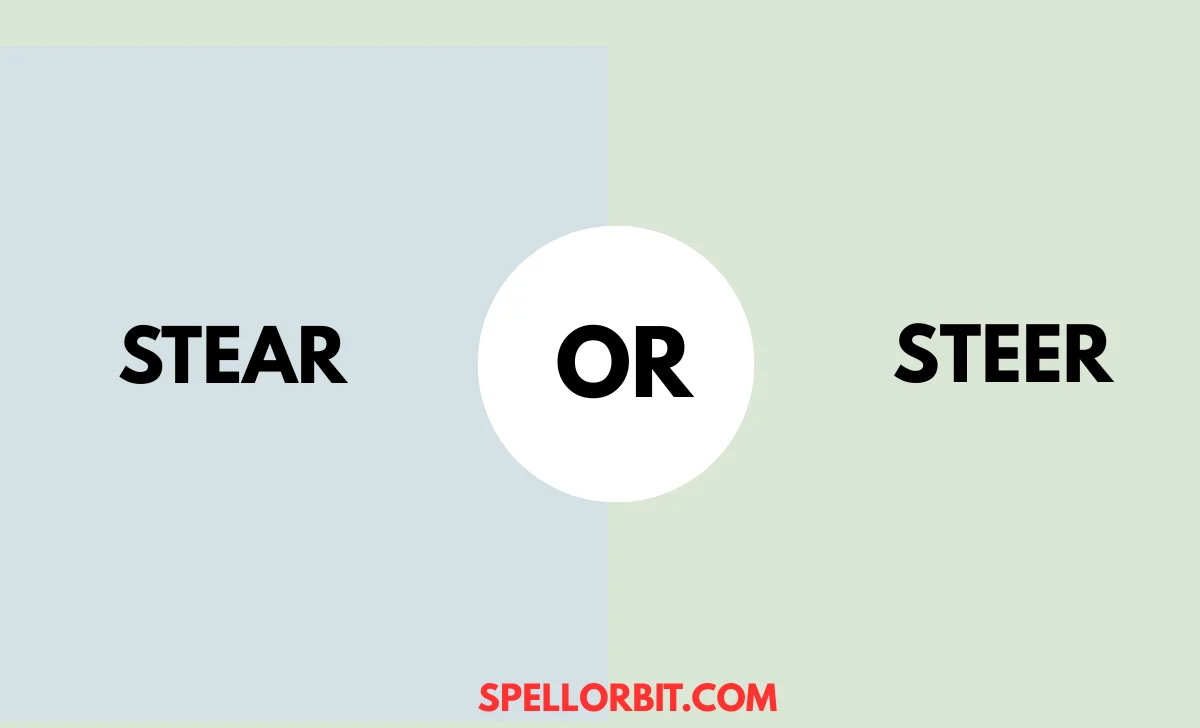
Steer is the correct spelling when you mean to guide, direct, or control something, while stear is a spelling error.
The confusion exists because both forms look possible and the vowel sound in steer does not always make its spelling obvious.
English has many words whose sounds do not clearly show their letters, so mistakes like stear can appear in writing, emails, and schoolwork.
In this guide, you will learn the meaning, origin, pronunciation, and correct use of steer.
You will also see British and American spelling rules, common mistakes, everyday examples, and practical tips for remembering the correct form.
Quick Answer
Steer is the correct spelling in standard English.
Stear is an incorrect spelling when you mean to guide, direct, or control something.
The word steer can be used as a verb or a noun.
As a verb, steer means to guide something in a particular direction.
- Please steer the car carefully.
- She learned to steer the boat.
- He tried to steer the conversation toward another topic.
As a noun, steer refers to a male cattle animal, especially one raised for beef.
- The farmer sold several steers.
- The ranch has a large steer.
So, if you are asking “stear or steer?”, choose steer.
Incorrect: Please stear the vehicle.
Correct: Please steer the vehicle.
There is no British-versus-American spelling difference here. Both varieties use steer.
The Origin of Stear or Steer
The correct word steer has a long history in English.
As a verb meaning “to guide” or “direct,” steer comes from Old English forms such as stīeran and stēoran. It developed through Middle English forms before reaching the modern spelling steer. The word has Germanic relatives, including words related to guiding, directing, and controlling.
The noun steer, meaning a young male ox or cattle animal, has a separate but related historical development. It comes from Old English stēor, meaning a young ox or bullock.
The modern verb is used in both physical and figurative ways.
For example:
- Physical: She steered the car around the corner.
- Navigation: The captain steered the ship toward the harbor.
- Figurative: The manager steered the team toward a better solution.
- Conversation: He steered the discussion away from politics.
The spelling stear does not represent a standard alternative form of this word. It generally appears because writers hear the sound and choose the wrong vowel combination.
English spelling can be difficult because pronunciation does not always tell you exactly which letters to use. That is why a form such as stear may look believable even though steer is the established spelling.
British English vs American English Spelling
There is no spelling difference between British English and American English for this word.
Both British and American English use:
steer
The incorrect form stear should not be used in either variety.
| English Variety | Correct Spelling | Incorrect Spelling | Example |
|---|---|---|---|
| British English | steer | stear | Steer the car carefully. |
| American English | steer | stear | Steer the boat toward the dock. |
| Canadian English | steer | stear | He learned to steer a canoe. |
| Australian English | steer | stear | She can steer the vehicle well. |
| Global English | steer | stear | Please steer the discussion. |
Some English words have genuine British and American spelling differences, such as colour/color, organise/organize, and travelling/traveling.
Steer is not one of them.
Whether you are writing for readers in London, New York, Toronto, Sydney, or elsewhere, use steer.
Which Spelling Should You Use?
Use steer regardless of your audience.
For American English
Use steer in school assignments, business writing, emails, articles, and everyday communication.
Example:
Please steer the vehicle into the right lane.
For British English
Use steer in the same situations.
Example:
The driver carefully steered around the obstacle.
For Commonwealth English
Australian, Canadian, and other Commonwealth English users should also write steer.
For Global English
If you write for an international audience, steer is the safest and standard choice.
The key point is simple: you do not need to change the spelling based on country.
Common Mistakes with Stear or Steer
The most common mistake is replacing ee with ea.
1. Writing “stear” instead of “steer”
Wrong: I will stear the boat.
Right: I will steer the boat.
2. Using “stear” in professional writing
Because stear is not the standard spelling, it can look like a typing or spelling mistake in an email, report, or formal document.
Wrong:
The manager will stear the project in a new direction.
Right:
The manager will steer the project in a new direction.
3. Confusing pronunciation with spelling
The pronunciation of steer can encourage learners to spell it incorrectly. English spelling is not always phonetic, so listening to the word alone may not reveal the correct letters.
4. Confusing steer with similar words
Some words sound or look similar but have different meanings.
| Word | Meaning | Example |
|---|---|---|
| steer | guide or direct | Steer the car carefully. |
| stare | look fixedly | Do not stare at people. |
| stair | a step in a staircase | Walk up the stair. |
| stear | Incorrect spelling of steer | ❌ Do not write “stear.” |
Understanding the meaning of each word makes it easier to choose the right spelling.
Stear or Steer in Everyday Examples
The word steer appears in many types of writing.
In Emails
Please steer the discussion toward the main issue.
I will steer the meeting back to our original topic.
In News Writing
The new policy could steer the economy toward stronger growth.
The captain successfully steered the vessel away from the storm.
In Social Media
Trying to steer my life in a better direction.
Sometimes you just need to steer clear of unnecessary drama.
In Formal Writing
The committee aims to steer the organization toward long-term growth.
The government introduced new measures to steer the industry toward cleaner energy.
In Everyday Conversation
Can you steer for a while?
She knows how to steer a boat.
I am trying to steer the conversation away from that subject.
As a Noun
Remember that steer can also refer to male cattle.
The farmer raised a healthy steer.
This noun meaning is different from the verb meaning, but the spelling remains the same.
Stear or Steer – Google Trends & Usage Data
Search interest around “stear or steer” is mainly driven by spelling confusion rather than by two competing standard spellings. Dictionary sources recognize steer, while stear is generally treated as an incorrect spelling when users intend the common English word.
Searches for this comparison can come from several groups:
- English learners checking spelling
- Students writing assignments
- Professionals checking emails
- Writers and bloggers checking word choice
- People correcting typing mistakes
- Users unsure about the ee vowel pattern
The correct word steer is used widely in contexts involving driving, navigation, management, direction, and figurative guidance.
It also appears in phrases such as:
- steer clear
- steer the car
- steer the boat
- steer the conversation
- steer the project
- steer toward
- steer away from
Because steer has several meanings and common expressions, its overall usage is much broader than the spelling question alone suggests.
Importantly, there is no evidence of a British-versus-American spelling split for steer. Both varieties use the same spelling.
Stear vs Steer – Comparison Table
| Feature | Stear | Steer |
|---|---|---|
| Standard English word? | No, when intended as “steer” | Yes |
| Correct spelling? | ❌ No | ✅ Yes |
| Meaning: guide/direct | ❌ | ✅ |
| Meaning: male cattle | ❌ | ✅ |
| British English | ❌ | ✅ |
| American English | ❌ | ✅ |
| Common in formal writing | ❌ | ✅ |
| Example | ❌ Stear the car. | ✅ Steer the car. |
How to Remember the Correct Spelling
A simple memory trick is to connect steer with steering.
Think:
steer → steering wheel → car
The word steering contains the same eer pattern:
- steer
- steering
- steered
- steerer
So, when you mean “guide,” remember steer with ee.
You can also remember this sentence:
You steer a vehicle with a steering wheel.
If you are about to write stear, stop and think of steering. That connection can help you choose the correct spelling.
Pronunciation of Steer
Steer is commonly pronounced /stɪr/ in American English and /stɪə/ in many British pronunciations, although pronunciation varies by accent.
It is closely associated with words such as:
- dear
- fear
- hear
- near
- clear
This pronunciation can make the spelling confusing because English does not always use a single predictable spelling pattern for a sound.
The important point is that pronunciation does not change the spelling.
Write:
steer
Not:
stear
FAQS
1. Is “stear” a correct word?
No, stear is not the standard spelling when you mean steer, meaning to guide or direct something.
2. Is it “steer” or “stear” a car?
The correct phrase is steer a car.
Example: She learned to steer a car at a young age.
3. Is steer British or American English?
Steer is used in both British and American English. There is no spelling difference between the two varieties.
4. What does steer mean?
As a verb, steer means to guide or control the direction of something. As a noun, it can mean a male cattle animal, especially one raised for beef.
5. Why do people spell steer as stear?
People may write stear because the pronunciation does not clearly reveal the spelling. Fast typing, phonetic spelling, and confusion with other vowel patterns can also cause the error.
6. What is the past tense of steer?
The past tense is steered.
Example: He steered the car around the corner.
7. What is the difference between steer and stare?
Steer means to guide or direct, while stare means to look at something or someone for a long time.
Example:
I steer the car carefully.
I stare at the painting.
Conclusion
Steer is the correct standard English spelling when you mean to guide, direct, or control, and stear is not an accepted alternative spelling.
The practical rule is simple: use steer for vehicles, boats, people, conversations, plans, and other things you guide.
Remembering steer as the word connected with steering a car can help you avoid the common vowel spelling mistake.
If you are learning other easily confused English words, read our related guide on “steer vs stare” to compare another pair with different meanings.
With these rules and examples, you can confidently choose steer in everyday, academic, and professional writing.
Related Posts:
- Skiied or Skied: Which Spelling Is Correct?
- Skiis or Skis: Which Spelling Is Correct?
- Monkies or Monkeys: Which Spelling Is Correct?