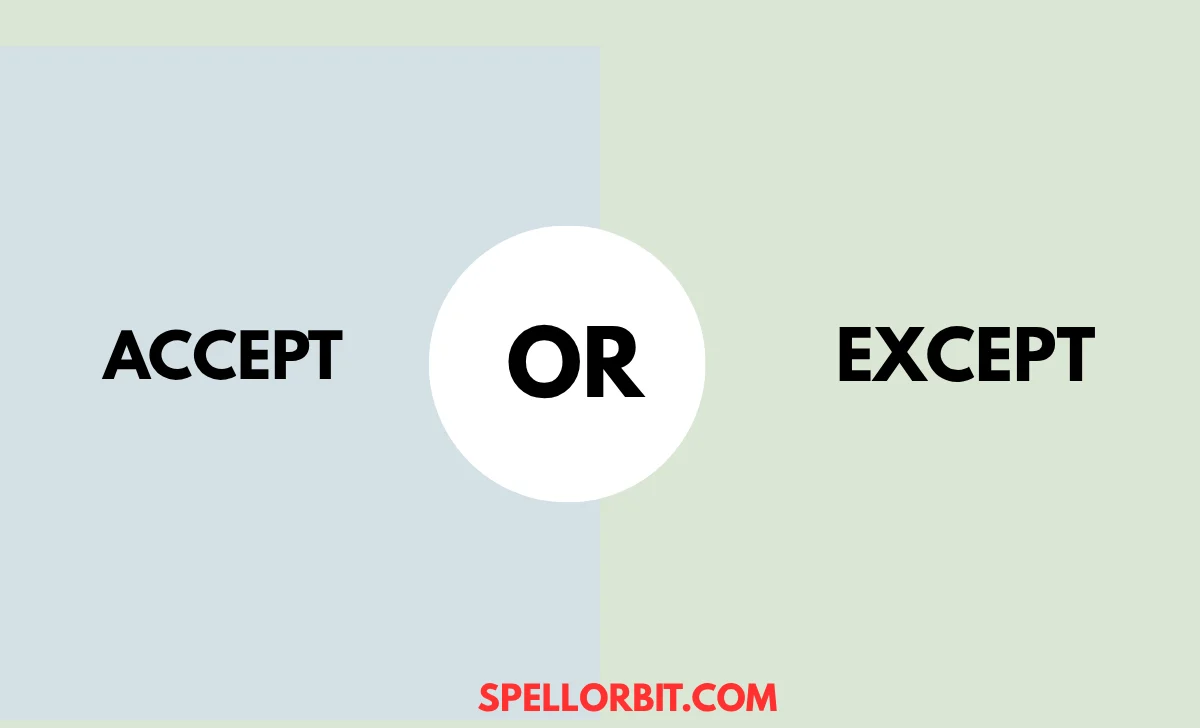
Accept vs except are commonly confused because they sound similar but have completely different meanings and grammatical roles.
Accept is a verb meaning to receive, agree to, or approve something. Except usually means excluding someone or something.
The confusion exists because both words have similar sounds and spelling patterns, especially in fast speech.
Understanding the difference helps you avoid mistakes in emails, schoolwork, professional writing, and everyday conversations.
This guide explains their meanings, origins, spelling differences, common mistakes, and practical examples.
You will learn when to use accept and when to use except, making your writing clearer and more accurate.
Quick Answer
The easiest way to remember accept vs except is:
- Accept = receive, agree to, or approve.
- Except = leave out or exclude.
Examples of Accept
- I accept your invitation.
- She accepted the job offer.
- Please accept this gift.
- He accepted responsibility for the mistake.
Examples of Except
- Everyone came except John.
- I like all fruits except bananas.
- The store is open every day except Sunday.
- The price includes everything except delivery.
Quick memory trick
Think of accept as saying “yes” to something.
Think of except as taking something “out.”
The Origin of Accept vs Except
Although accept and except look and sound similar, they developed from different Latin roots.
Accept comes from the Latin accipere, meaning “to receive” or “take.” It entered English through Old French and developed into the modern verb accept.
Except comes from the Latin excipere, meaning “to take out” or “exclude.” It also entered English through French before becoming the English word we use today.
Their similar endings can make them confusing, but their prefixes provide a useful clue:
- ac- in accept is connected with the idea of receiving or taking toward oneself.
- ex- in except carries the sense of “out” or “away.”
This difference in origin helps explain why the words have different meanings despite their similar appearance.
British English vs American English Spelling
There is no major spelling difference between British and American English for accept and except.
Both varieties use:
- accept
- accepted
- accepting
- acceptance
- except
- exception
- excepted
The meanings also remain essentially the same in both forms of English.
| Word | American English | British English | Meaning |
|---|---|---|---|
| Accept | accept | accept | Receive, agree, or approve |
| Accepted | accepted | accepted | Received or approved |
| Accepting | accepting | accepting | Agreeing to or receiving |
| Acceptance | acceptance | acceptance | Agreement or approval |
| Except | except | except | Excluding |
| Exception | exception | exception | Something excluded from a rule |
Unlike words such as color/colour or organize/organise, accept and except do not change spelling based on whether you are writing for an American or British audience.
Which Spelling Should You Use?
The correct word depends on meaning, not geography.
For a US audience
Use accept when you mean receive, approve, or agree.
I accept your proposal.
Use except when you mean excluding.
Everyone attended except Mark.
For a UK or Commonwealth audience
The same rule applies.
She accepted the invitation.
All departments are open except Finance.
For a global audience
Focus on the meaning and sentence structure rather than regional spelling. Both words are internationally recognized, so there is no need to choose an American or British spelling.
Common Mistakes with Accept vs Except
Mistake 1: Using except when you mean receive
Incorrect:
I except your apology.
Correct:
I accept your apology.
Mistake 2: Using accept when you mean exclude
Incorrect:
Everyone was invited accept Tom.
Correct:
Everyone was invited except Tom.
Mistake 3: Confusing “accept” with “except” in formal writing
Incorrect:
We accept all applications except those submitted late.
This sentence is actually correct because accept means receive and except means excluding.
The problem occurs when writers replace one word with the other without checking the meaning.
Mistake 4: Confusing “accept” with “agree”
Accept can sometimes mean agree to something, but it can also mean receive something.
She accepted the award.
He accepted the terms.
Mistake 5: Forgetting the noun “exception”
The noun related to except is exception.
There is one exception to the rule.
Not:
There is one acceptation to the rule.
Accept vs Except in Everyday Examples
Understanding how the words appear in real situations makes the difference easier to remember.
In Emails
Accept:
I am pleased to accept your meeting invitation.
Except:
The office is available every afternoon except Friday.
In News
Accept:
The company accepted the new agreement.
Except:
All flights arrived on time except one.
On Social Media
Accept:
I accept your challenge!
Except:
Everyone loved the movie except me.
In Formal Writing
Accept:
The committee accepted the proposed changes.
Except:
The policy applies to all employees except temporary workers.
In Everyday Conversation
Accept:
I accept your apology.
Except:
I eat almost everything except seafood.
Accept vs Except – Google Trends & Usage Data
Search interest for accept and except appears across English-speaking regions because both are common English words. Their usage is not limited to a particular country or dialect.
The main difference is context.
Accept frequently appears in contexts involving:
- invitations
- offers
- applications
- responsibility
- apologies
- decisions
- agreements
- gifts
Except commonly appears in contexts involving:
- exclusions
- rules
- exceptions
- lists
- restrictions
- comparisons
- schedules
Because both words are frequently used in everyday English, spelling questions about accept vs except often come from learners and writers who recognize their similar pronunciation but need help distinguishing their meanings.
Accept vs Except Comparison Table
| Feature | Accept | Except |
|---|---|---|
| Part of speech | Mainly verb | Mainly preposition/conjunction |
| Main meaning | Receive, agree, approve | Exclude or leave out |
| Example | I accept your offer. | Everyone came except Lisa. |
| Related noun | Acceptance | Exception |
| Memory clue | Say yes | Leave out |
| British spelling | Accept | Except |
| American spelling | Accept | Except |
| Common error | Using “except” for receiving | Using “accept” for excluding |
Accept vs Except: Easy Way to Remember
Use this simple rule:
Accept = Agree or Receive
Except = Exclude
For example:
I accept the invitation.
You are agreeing to receive or take part in something.
Everyone came except Sarah.
Sarah is excluded from the group.
Another useful memory trick is to connect except with exception. Both involve something being left outside a general rule.
FAQS
1. What is the difference between accept and except?
Accept means to receive, agree to, or approve something. Except means to exclude or leave someone or something out.
2. Is it “accept my apology” or “except my apology”?
The correct phrase is “accept my apology.” You are asking someone to receive or acknowledge your apology.
3. Is it “everyone accept John” or “everyone except John”?
The correct phrase is “everyone except John.” John is being excluded from the group.
4. Are accept and except pronounced the same?
They are often pronounced similarly, but their vowel sounds are different in standard pronunciation. Accept begins with an unstressed “uh” sound, while except begins with an “ik” sound.
5. Is accept a verb?
Yes. Accept is primarily a verb.
She accepted the offer.
6. Is except a verb?
Except can function as a preposition, conjunction, and sometimes a verb, although its use as a verb is less common.
Everyone agreed except Tom.
7. How can I remember accept vs except?
Remember accept = receive or agree, while except = exclude. If something is being left out, use except.
Conclusion
Accept means to receive, agree to, or approve something, while except means to exclude or leave something out.
The spelling is the same in both British and American English, so the correct choice depends entirely on meaning and sentence structure.
A practical way to remember the difference is accept = receive or agree, while except = exclude.
For example, you can accept an invitation, but everyone may attend except one person.
For another useful guide on commonly confused English words, consider linking this article to a related post such as “Then vs Than.”
Related Posts:
- Specialty vs Speciality: Which Spelling Is Correct?
- Consensus vs Concensus: Which Spelling Is Correct?
- Afterward vs Afterwards: Which Spelling Is Correct?