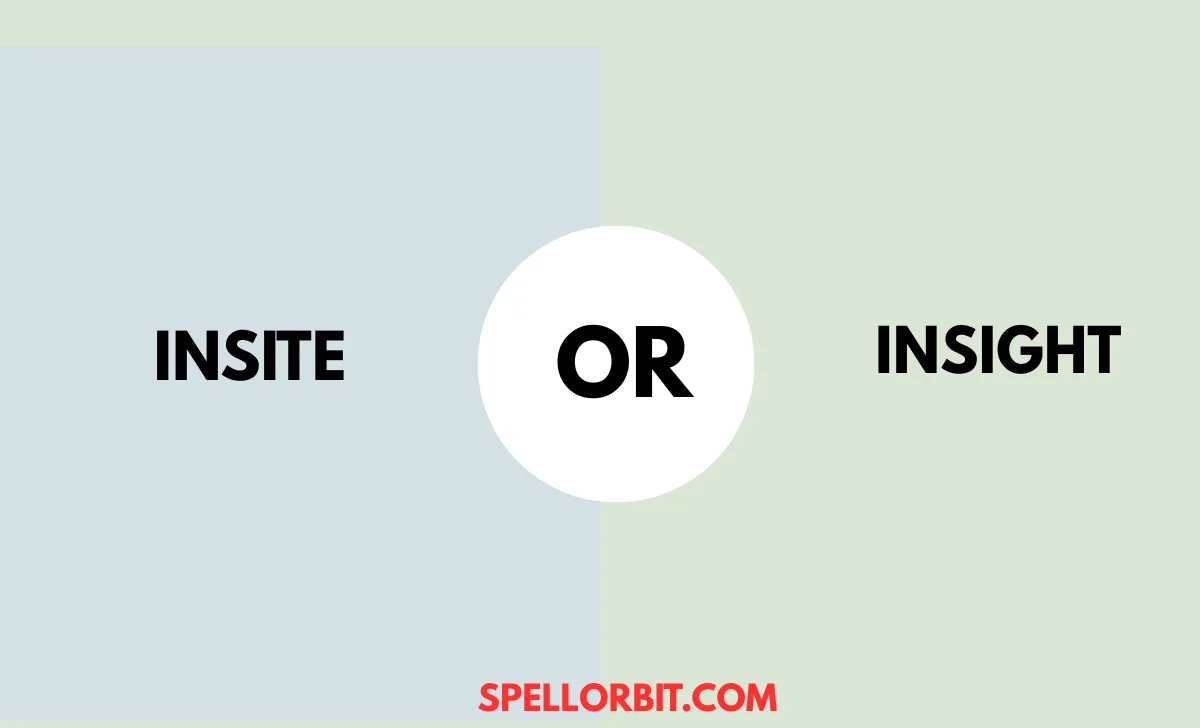
The correct spelling is insight, not insite, when you mean a deep understanding of a person, situation, or idea.
The word insite is usually a spelling mistake caused by the similar sounds of insight and words such as site and sight.
Since English contains many words that sound alike but have different spellings and meanings, this mistake is common in emails, schoolwork, and online writing.
In this guide, you will learn the meaning, origin, pronunciation, and correct use of insight.
You will also see British and American English examples, common mistakes, everyday uses, usage patterns, and simple ways to remember the correct spelling.
Quick Answer
Insight is the correct spelling when you mean a clear or deep understanding of something.
Insite is generally incorrect in standard English when it is intended to mean insight.
Examples:
- Her advice gave me valuable insight into the problem.
- The report provides useful insight into customer behavior.
- His experience gave him great insight into the industry.
- The teacher offered an important insight into the topic.
What does insight mean?
Insight means a deep understanding of something.
It can describe understanding a:
- person
- problem
- situation
- idea
- subject
- process
For example:
The interview gave us new insight into her career.
Here, insight means useful understanding or knowledge.
What is “insite”?
In most cases, insite is simply a misspelling of insight.
If you want to say that someone has a deep understanding, use insight.
The Origin of Insight
The word insight comes from Old English. It is formed from words meaning “in” and “sight.”
The basic idea is seeing into something, not just seeing its surface.
Over time, insight developed its modern meaning of having a clear or deep understanding of something.
The word sight is important here because insight is historically connected with the idea of seeing or understanding.
This also explains why people may write insite. They may hear the ending as site and spell the word based on its sound.
However, the correct word is:
in + sight = insight
Not:
in + site = insite
The spelling reflects the original connection with sight.
British English vs American English Spelling
There is no spelling difference between British English and American English for this word.
Both use:
insight
Examples:
British English:
The report provides valuable insight into the issue.
American English:
The report provides valuable insight into the issue.
The spelling remains the same in both varieties.
| Meaning | British English | American English |
|---|---|---|
| Deep understanding | insight | insight |
| Plural | insights | insights |
| Incorrect spelling | insite | insite |
Unlike words such as colour/color or centre/center, insight does not change between British and American English.
Which Spelling Should You Use?
Use insight in all standard English writing.
For American English
Write:
The study provides useful insight into the market.
For British English
Write:
The study provides useful insight into the market.
For Commonwealth English
Countries that commonly use British English standards should also use insight.
For global English
Insight is the safest and correct spelling for international communication.
Use it in:
- emails
- reports
- essays
- business documents
- presentations
- websites
- social media
- academic writing
Avoid insite when you mean deep understanding.
Common Mistakes with Insite or Insight
1. Writing “insite” instead of “insight”
Incorrect:
The research gives us new insite into the problem.
Correct:
The research gives us new insight into the problem.
2. Confusing insight with sight
Sight relates to seeing.
The mountain was a beautiful sight.
Insight means understanding.
The book gave me valuable insight.
3. Confusing insight with site
A site is a place or location.
They visited the construction site.
Insight means understanding.
She offered valuable insight into the issue.
4. Using “insites” instead of “insights”
The correct plural is:
insights
Example:
The survey revealed several useful insights.
5. Using “insight” when you mean physical location
Incorrect:
We visited the new insight yesterday.
Correct:
We visited the new site yesterday.
Insite or Insight in Everyday Examples
In emails
Thank you for sharing your insight on this matter.
In business writing
The survey provides valuable insight into customer needs.
In news writing
The report offers new insight into the causes of the problem.
On social media
This post gave me a completely new insight into the topic.
In academic writing
The study provides important insight into language development.
In formal writing
The findings offer useful insight into the effects of the policy.
In everyday conversation
Her experience gave her a lot of insight into the situation.
Insight – Google Trends & Usage Data
Searches for “insite or insight” are mainly connected with spelling and grammar questions. People often search for this phrase when they are unsure whether the final sound should be written as -site or -sight.
The standard English word is insight, and it is widely used in professional, academic, business, and everyday contexts.
Search interest can also be affected by the different meanings of related words such as site and sight. These words sound similar but have different meanings and spellings.
The word insight is especially common in contexts such as:
- business analysis
- psychology
- education
- research
- marketing
- journalism
- personal development
- technology
Because insight has many uses, it appears frequently in both formal and everyday English.
Insite vs Insight: Comparison Table
| Word | Correct? | Meaning | Example |
|---|---|---|---|
| insight | Yes | Deep understanding | Her advice gave me useful insight. |
| insite | No | Common spelling error | She gave me useful insite. |
| insights | Yes | More than one useful understanding | The study provided several insights. |
| sight | Yes | Ability to see or something seen | The sunset was a beautiful sight. |
| site | Yes | A place or location | They visited the building site. |
Easy Trick to Remember Insight
Use this simple memory trick:
Insight = in + sight
Think of insight as “seeing into” something.
Remember:
Insight helps you see deeper.
The ending is -sight, not -site.
You can also connect the word to sight:
- sight = seeing
- insight = understanding
This makes the spelling easier to remember.
Why Do People Confuse Insite and Insight?
The main reason is pronunciation.
Insight is pronounced approximately:
/ˈɪn.saɪt/
The ending sounds like site and sight, which are pronounced the same.
This creates a common spelling problem because English has many homophones.
For example:
- site = a place
- sight = something seen
- insight = deep understanding
The sound alone cannot tell you which spelling is correct. You need to understand the meaning and remember that insight contains sight.
FAQS
Is “insite” a correct spelling?
Usually, no. If you mean deep understanding, the correct spelling is insight.
Is it insight or insite?
It is insight when you mean understanding, knowledge, or awareness.
What does insight mean?
Insight means a clear or deep understanding of a person, problem, situation, or subject.
What is the plural of insight?
The plural is insights.
The report contains several useful insights.
Is insight the same as sight?
No. Sight relates to seeing, while insight means deep understanding.
Is insight the same in British and American English?
Yes. Both British and American English use insight.
How can I remember the spelling of insight?
Remember in + sight = insight. The word contains sight, not site.
Conclusion
The correct spelling is insight, not insite, when you mean deep understanding or clear awareness, and the word is spelled the same in British and American English.
The main reason for the mistake is that insight sounds like it ends with site, while its spelling actually contains sight.
The practical takeaway is to remember in + sight = insight and use insight in emails, essays, reports, business writing, and everyday communication.
If you want to learn another common spelling difference, read our related guide on “develope or develop” for another useful English spelling lesson.
Related Posts:
- Excell or Excel: Which Spelling Is Correct?
- Skiied or Skied: Which Spelling Is Correct?
- Stear or Steer: Which Spelling Is Correct?