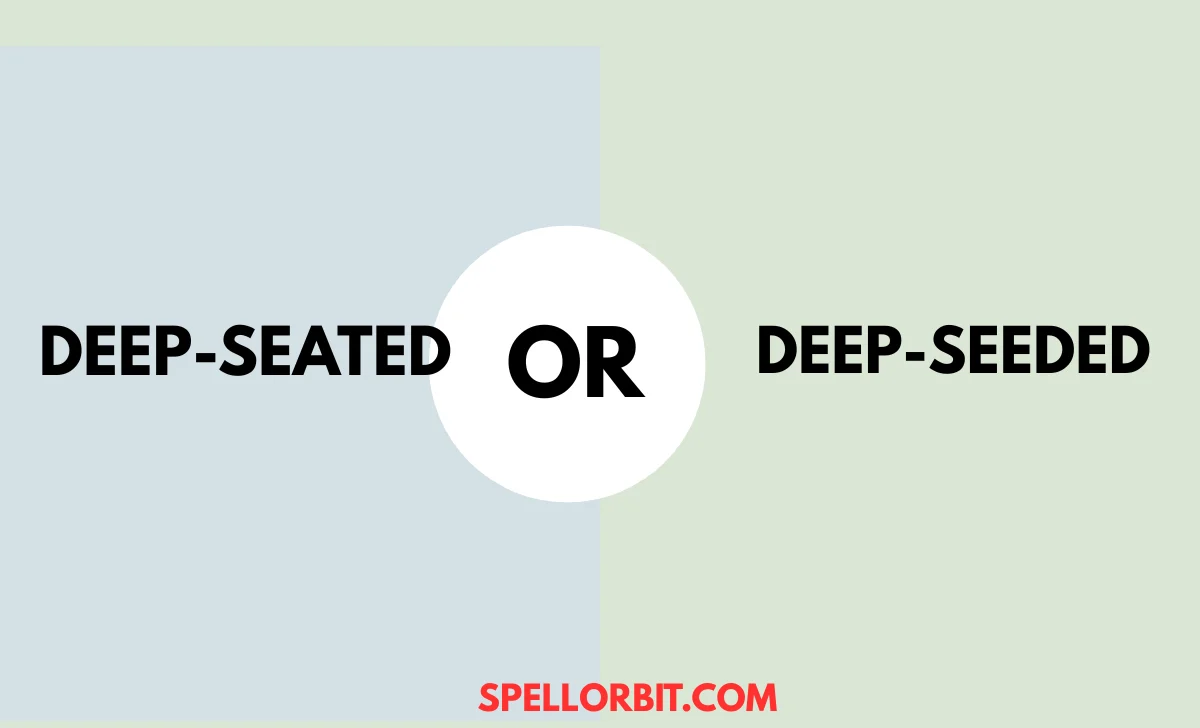
Deep-seated is the correct spelling when you mean something that is firmly fixed, deeply rooted, or strongly established.
Deep-seeded is a common mistake caused by the word “seed,” which sounds logical because seeds are planted deep in the ground.
The phrase usually describes feelings, beliefs, habits, problems, or attitudes that have existed for a long time and are difficult to change.
This confusion happens because “seated” and “seeded” sound similar when spoken quickly.
In this guide, you will learn the correct spelling, meaning, origin, British and American usage, common mistakes, and practical examples so you can use the phrase correctly in professional and everyday writing.
Quick Answer
Deep-seated is the correct expression.
It means something that is firmly established, deeply rooted, or strongly held.
Examples:
- She has a deep-seated fear of flying.
- The company has a deep-seated problem with communication.
- He has a deep-seated belief in fairness.
- The conflict comes from deep-seated differences.
Deep-seeded is generally considered an incorrect spelling when used with this meaning.
The confusion is easy to understand. “Seeded” relates to seeds, so it may seem natural to say that a belief or feeling is “deep-seeded.” However, the established phrase is deep-seated.
A simple rule is:
If you mean “deeply rooted” or “firmly established,” use deep-seated.
The Origin of Deep-Seated vs Deep-Seeded
The phrase deep-seated comes from the word seat. Here, “seat” does not mean a chair. It refers to a place where something is firmly positioned or established.
The idea is that a feeling, belief, or problem has a deep “seat” within a person or situation. In other words, it is firmly fixed and not easy to remove.
The word seated has Old English roots connected with sitting or being placed in a position. Over time, the figurative meaning developed. Something could be “seated” deeply in the mind, heart, or character.
For example:
- a deep-seated belief
- a deep-seated fear
- a deep-seated habit
- a deep-seated resentment
Deep-seeded developed as a spelling mistake influenced by the familiar word seeded. Because a seed can be planted deep in soil, “deep-seeded” appears logical at first glance. However, it is not the standard form of the idiom.
The two words are also easy to confuse because seated and seeded can sound similar in connected speech.
British English vs American English Spelling
There is no British vs American spelling difference for this phrase.
Both British English and American English use:
deep-seated
The incorrect form deep-seeded should not be used in standard formal writing in either variety.
| Meaning | British English | American English |
|---|---|---|
| Firmly established | deep-seated | deep-seated |
| Strongly rooted feeling | deep-seated | deep-seated |
| Long-standing problem | deep-seated | deep-seated |
| Common incorrect form | deep-seeded | deep-seeded |
Examples in both forms of English:
British English:
The country faces several deep-seated economic problems.
American English:
The country faces several deep-seated economic problems.
The spelling remains the same.
Which Spelling Should You Use?
Use deep-seated in all standard English writing.
US English
American writers should use deep-seated in school, business, journalism, and professional documents.
Correct:
The organization has a deep-seated culture of innovation.
UK and Commonwealth English
British, Australian, Canadian, and other Commonwealth writers should also use deep-seated.
Correct:
The dispute reflects a deep-seated social problem.
Global English
For international communication, deep-seated is the safest choice because it is the standard form recognized across major varieties of English.
Avoid deep-seeded unless you are specifically discussing seeds or planting.
Common Mistakes with Deep-Seated vs Deep-Seeded
Mistake 1: Writing “deep-seeded fear”
Incorrect:
She has a deep-seeded fear of water.
Correct:
She has a deep-seated fear of water.
Mistake 2: Thinking “seeded” means deeply rooted
The word “seeded” can relate to planting seeds, but it is not the word used in this idiom.
Incorrect:
The issue is caused by a deep-seeded belief.
Correct:
The issue is caused by a deep-seated belief.
Mistake 3: Using “deep seated” without a hyphen
When the phrase comes directly before a noun as a compound adjective, deep-seated is normally written with a hyphen.
Correct:
He has a deep-seated dislike of dishonesty.
Mistake 4: Confusing the phrase with actual seeds
If you are literally talking about seeds placed deep in soil, deep-seeded can have a literal meaning in certain contexts. But that is different from the established idiom deep-seated.
Deep-Seated vs Deep-Seeded in Everyday Examples
In Emails
Correct:
The team has a deep-seated concern about the new policy.
Correct:
We need to address this deep-seated issue before moving forward.
In News Writing
Correct:
The reform aims to address deep-seated economic problems.
Correct:
The dispute reflects deep-seated political tensions.
On Social Media
Correct:
Some people have a deep-seated fear of public speaking.
Correct:
That kind of reaction often comes from a deep-seated belief.
In Formal Writing
Correct:
The research suggests that the problem is linked to deep-seated social attitudes.
In Everyday Conversation
Correct:
I think that fear is pretty deep-seated.
The expression works well with emotions, beliefs, attitudes, habits, conflicts, problems, and social conditions.
Deep-Seated vs Deep-Seeded – Google Trends & Usage Data
Search interest for deep-seated is much stronger than for deep-seeded because deep-seated is the standard expression.
The correct form appears in many types of writing, including:
- News articles
- Academic writing
- Business reports
- Books
- Government documents
- Essays
- Everyday communication
Deep-seeded often appears because people spell the phrase based on how they understand its meaning. The “seed” connection makes the error especially tempting.
Usage can vary by context, but the spelling rule does not change by country:
deep-seated = standard phrase
deep-seeded = usually an error when expressing the idiom
When writing for SEO, business, education, or professional audiences, use deep-seated.
Deep-Seated vs Deep-Seeded Comparison Table
| Feature | Deep-Seated | Deep-Seeded |
|---|---|---|
| Standard spelling | Yes | No, for the idiom |
| Meaning | Firmly established or deeply rooted | Not the standard idiom |
| Used for feelings | Yes | No |
| Used for beliefs | Yes | No |
| Used for problems | Yes | No |
| Used in formal writing | Yes | Avoid |
| British English | Correct | Incorrect for the idiom |
| American English | Correct | Incorrect for the idiom |
| Example | deep-seated fear | deep-seeded fear |
Easy Way to Remember Deep-Seated
Think of seat = position.
If something is deep-seated, it has a deep position within a person, mind, system, or situation.
You can remember it with this simple sentence:
A deep-seated belief has a deep seat in the mind.
Do not connect the expression with seeds unless you are talking literally about planting.
Deep-Seated vs Deep-Seeded: Sentence Examples
Here are more examples to make the difference clear:
- She has a deep-seated fear of failure.
- The company must solve its deep-seated management problems.
- His deep-seated beliefs influence his decisions.
- The disagreement is rooted in deep-seated differences.
- They are trying to overcome deep-seated prejudice.
- The community has a deep-seated distrust of the government.
- Her deep-seated habits are difficult to change.
- The conflict has deep-seated historical causes.
- The problem is more deep-seated than we expected.
- He has a deep-seated desire to succeed.
In every example, deep-seated means something firmly established or deeply rooted.
FAQS
Is deep-seated or deep-seeded correct?
Deep-seated is correct when you mean something deeply rooted, firmly established, or strongly held. Deep-seeded is a common spelling error for this idiom.
What does deep-seated mean?
Deep-seated means firmly established or deeply rooted. It often describes feelings, beliefs, fears, attitudes, habits, and problems.
Is deep-seated hyphenated?
Yes. When used as a compound adjective before a noun, the standard form is deep-seated.
For example: “a deep-seated fear.”
Is deep-seated used in British English?
Yes. British English uses deep-seated, just like American English.
Is deep-seeded ever correct?
It can occur literally when discussing something related to seeds, but it is not the standard spelling of the idiom meaning “deeply rooted.”
Why do people write deep-seeded?
People often write deep-seeded because “seeded” seems to fit the idea of something planted deeply. The phrase, however, comes from seated, not seeded.
What is a synonym for deep-seated?
Common synonyms include deep-rooted, firmly established, ingrained, entrenched, longstanding, and strongly held.
Conclusion
Deep-seated is the correct spelling when describing something firmly established, deeply rooted, or strongly held, while deep-seeded is normally a misspelling of this expression.
The key rule is simple: use seated, not seeded, when talking about deep feelings, beliefs, fears, habits, attitudes, or problems.
Remember that the phrase suggests something has a deep “seat” within a person or situation, which makes the correct spelling easier to recall.
If you want to explore another commonly confused word pair, read our related post on “deep-seated vs deep-seeded” and continue building your English vocabula
Related Posts:
- Canvas vs Canvass: Meaning, Spelling, and Usage Explained
- Partier vs Partyer: Which Spelling Is Correct?
- Molding vs Moulding: What Is the Difference?