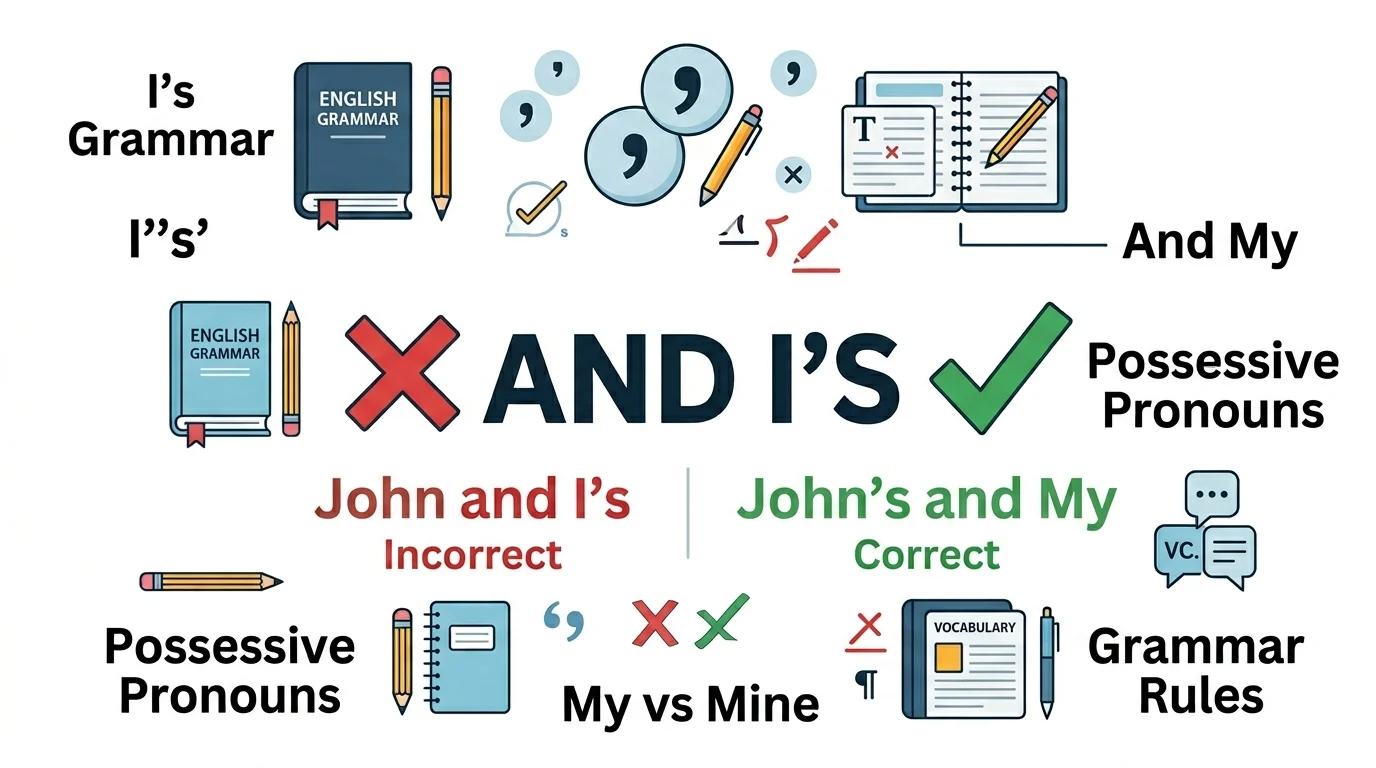
Have you ever written phrases like “John and I’s house,” “Sarah and I’s project,” or “my brother and I’s car” and wondered whether they are grammatically correct? If so, you’re not alone.
Many English speakers use and I’s in everyday conversation because it sounds natural, yet many teachers, editors, and grammar experts consider it problematic.
The confusion comes from how English handles possession in compound phrases. While expressions such as John and I’s, he and I’s, name and I’s, and his and I’s are common in speech, they often raise questions in formal writing.
In this guide, you’ll learn whether and I’s is correct grammar, why it sounds acceptable to many speakers, what grammar authorities say about it, and which alternatives are preferred in professional and academic writing.
Quick Answer
Is “And I’s” Correct Grammar?
In formal English, and I’s is generally considered incorrect or awkward.
Most grammar experts recommend replacing phrases such as:
❌ John and I’s house
❌ Sarah and I’s project
❌ My wife and I’s anniversary
with clearer alternatives such as:
✅ John’s and my house
✅ Sarah’s project and mine
✅ Our anniversary
Short Answer
While many native speakers use and I’s in conversation, it is usually avoided in formal writing because I does not traditionally take the possessive form I’s.
What Does “And I’s” Mean?
The phrase and I’s is usually an attempt to show shared possession.
Common Usage in Everyday English
When someone says:
John and I’s car
they usually mean:
The car that belongs to John and me.
Likewise:
Sarah and I’s presentation
means:
The presentation that belongs to Sarah and me.
The intended meaning is usually clear, even if the grammar is debated.
Why People Use It
Many speakers naturally add ‘s to the end of an entire phrase because that’s how English often marks possession.
For example:
✅ John’s car
✅ Sarah’s book
So people extend the same pattern and create:
❌ John and I’s car
Although common in speech, many editors still prefer alternative constructions.
Why “And I’s” Sounds Natural
One reason this expression is so widespread is that it follows a pattern our brains expect.
Hypercorrection Explained
Many English speakers learn that saying:
❌ Me and John went to the store.
is incorrect.
Teachers often encourage:
✅ John and I went to the store.
As a result, speakers become accustomed to using I whenever another person’s name appears before it.
This can lead to phrases such as:
❌ John and I’s house
because the speaker assumes I must still be correct.
Influence of School Grammar Rules
Traditional grammar lessons focus heavily on choosing between I and me.
However, they rarely explain what happens when possession enters the picture.
This gap in instruction contributes to the popularity of and I’s.
The Structure Rule: Why “I’s” Is Controversial
The debate centers on how English pronouns form possession.
Possessive Nouns
Regular nouns easily form possessives.
Examples:
- John’s laptop
- Sarah’s office
- Michael’s car
The apostrophe + s pattern works naturally.
Possessive Pronouns
Pronouns work differently.
Instead of adding ‘s, English uses special possessive forms.
| Subject Pronoun | Possessive Form |
|---|---|
| I | My / Mine |
| He | His |
| She | Her / Hers |
| We | Our / Ours |
| They | Their / Theirs |
Notice something important:
There is no standard possessive pronoun I’s in traditional English grammar.
Why “I’s” Creates Debate
Because English already has my and mine, many grammar experts argue that I’s is unnecessary.
That’s why phrases such as:
❌ John and I’s house
often receive corrections in edited writing.
What Is the Possessive Form of I?
This is one of the most searched grammar questions online.
My
My is the most common possessive form of I.
Examples:
- My book
- My office
- My idea
Mine
Mine functions as an independent possessive pronoun.
Examples:
- The book is mine.
- That desk is mine.
Myself
Myself is a reflexive pronoun, not a possessive pronoun.
Examples:
- I taught myself Spanish.
- I prepared the report myself.
Why Not “I’s”?
Traditional English grammar uses my and mine instead of creating a possessive form such as I’s.
This is why many style guides discourage expressions like and I’s in formal writing.
And I’s or And My?
Many users search for and I’s or and my because they are unsure which form sounds more natural.
Consider this example:
❌ John and I’s house
A preferred alternative is:
✅ John’s and my house
Even better in many situations:
✅ Our house
The word my already functions as the possessive form of I, making it the safer grammatical choice.
John and I’s: Is It Correct?
Spoken English Perspective
In conversation, many native speakers say:
- John and I’s project
- John and I’s vacation
- John and I’s dog
Most listeners understand exactly what is meant.
Formal Grammar Perspective
In formal writing, many editors would revise these phrases to:
- John’s and my project
- John’s and my vacation
- John’s and my dog
or simply:
- Our project
- Our vacation
- Our dog
The revised versions are generally preferred in professional and academic contexts.
He and I’s: Is It Correct?
Another common question is whether phrases like he and I’s are grammatically acceptable.
Spoken English Usage
In casual conversation, some speakers may say:
❌ He and I’s project was successful.
❌ He and I’s teacher recommended the book.
These expressions are understandable, but they often sound awkward in formal writing.
Preferred Alternatives
Most grammar experts recommend rewriting such sentences.
Instead of:
❌ He and I’s project was successful.
Use:
✅ His and my project was successful.
Or even better:
✅ Our project was successful.
The revised versions are clearer and follow standard grammar conventions.
His and I’s or His and My?
This is one of the most frequently searched variations of the topic.
When expressing shared possession, his and my is generally preferred over his and I’s.
Incorrect
❌ His and I’s presentation received positive feedback.
Better
✅ His and my presentation received positive feedback.
Often Best
✅ Our presentation received positive feedback.
In most situations, our creates the most natural sentence.
Name and I’s: Is It Correct?
Writers often replace the name with a specific person.
Examples include:
- Sarah and I’s house
- David and I’s business
- Emma and I’s wedding plans
Although these phrases are common in speech, many editors consider them awkward in formal English.
Better Alternatives
Instead of:
❌ Sarah and I’s house
Use:
✅ Sarah’s and my house
Or:
✅ Our house
Likewise:
❌ David and I’s business
Can become:
✅ David’s and my business
Or:
✅ Our business
Is Name and I’s Correct?
The short answer is: not in formal grammar.
While many native speakers naturally use constructions like:
- John’s and I’s project
- Sarah and I’s apartment
- Michael and I’s company
most style-conscious writers choose alternative wording.
Why Grammar Experts Object
The issue is not with the name itself.
The problem comes from attaching ‘s to a phrase that ends with I, a pronoun that already has possessive forms (my and mine).
As a result, many editors prefer:
✅ John’s and my project
✅ Sarah’s and my apartment
✅ Michael’s and my company
or simply:
✅ Our project
✅ Our apartment
✅ Our company
Shared Ownership vs Separate Ownership
Understanding ownership helps solve many grammar problems.
Shared Ownership
When two people own something together, possession is shared.
Example:
John and Mary’s house
This means John and Mary jointly own one house.
More Examples
- Sarah and Tom’s business
- Emma and David’s restaurant
- Alex and Rachel’s car
Each example refers to one item owned together.
Separate Ownership
Separate ownership means each person owns something individually.
Example:
John’s and Mary’s houses
This implies John owns one house and Mary owns another.
Why This Matters
When using pronouns, writers often struggle because English handles possession differently with pronouns than with nouns.
Understanding ownership helps you choose a clearer structure.
The Removal Test: A Simple Grammar Trick
One of the easiest ways to check whether a sentence sounds correct is the Removal Test.
Remove the Other Person
Look at the sentence:
❌ John and I’s house is on the corner.
Remove John and.
You get:
❌ I’s house is on the corner.
Read the Sentence Again
Does I’s house sound natural?
Most people immediately recognize that it sounds incorrect.
Fix the Sentence
Replace the structure with:
✅ John’s and my house is on the corner.
Or:
✅ Our house is on the corner.
The Removal Test quickly reveals why many editors avoid and I’s.
Better Alternatives to “And I’s”
Fortunately, English offers several natural alternatives.
Use “My”
Instead of:
❌ Sarah and I’s report
Use:
✅ Sarah’s and my report
Use “Our”
Instead of:
❌ Sarah and I’s report
Use:
✅ Our report
Rewrite the Sentence
Instead of:
❌ John and I’s vacation was memorable.
Use:
✅ The vacation John and I took was memorable.
Rewriting often produces the smoothest result.
Formal vs Informal Usage
Not all English follows the same standards.
Academic Writing
Academic writing generally avoids and I’s.
Professors, editors, and style guides typically recommend alternative constructions.
Business Writing
Professional communication values clarity.
Most business documents replace:
❌ John and I’s proposal
with:
✅ John’s and my proposal
or:
✅ Our proposal
Casual Conversation
In speech, many native speakers regularly use:
- John and I’s
- Sarah and I’s
- He and I’s
Although common, these forms remain controversial among grammar experts.
Social Media and Informal Writing
Informal platforms often prioritize natural speech over strict grammar rules.
As a result, and I’s appears frequently online.
What Major Style Guides and Editors Prefer
Many editors favor constructions that avoid I’s altogether.
Traditional Grammar View
Traditional grammar recognizes:
- My
- Mine
but not:
- I’s
Because of this, editors often revise sentences containing and I’s.
Modern Usage Perspective
Some modern linguists acknowledge that expressions like John and I’s are widespread in spoken English.
However, acceptance in conversation does not necessarily mean acceptance in formal writing.
Practical Recommendation
If your audience includes teachers, editors, employers, or academic readers, choose:
- My
- Mine
- Our
instead of I’s.
Why You Hear “John and I’s” So Often
Despite criticism from grammar experts, the expression remains common.
Natural Speech Patterns
People naturally place possession at the end of a phrase.
For example:
- John’s car
- Sarah’s book
This pattern encourages speakers to say:
- John and I’s car
even if traditional grammar objects.
Language Change
English constantly evolves.
Many expressions once considered incorrect eventually became accepted.
Some linguists argue that John and I’s may become more widely accepted over time.
Regional Variation
Acceptance can vary depending on region, dialect, education level, and formality.
This explains why some speakers hear the phrase frequently while others rarely encounter it.
Common Mistakes to Avoid
Using “Me and John’s”
Incorrect:
❌ Me and John’s project
Correct:
✅ John’s and my project
✅ Our project
Omitting Possession Entirely
Incorrect:
❌ John and I project
Correct:
✅ John’s and my project
Overusing I’s
Some writers insert I’s simply because they are unsure which pronoun to use.
Remember:
My and mine are already the accepted possessive forms of I.
Confusing My and Mine
Use my before a noun.
✅ My report
Use mine when the noun is understood.
✅ The report is mine.
Example Sentences
Preferred Alternatives
✅ John’s and my presentation was successful.
✅ Our presentation was successful.
✅ Sarah’s and my apartment is downtown.
Informal Spoken Examples
❌ John and I’s presentation
❌ Sarah and I’s apartment
❌ He and I’s project
These may occur in conversation but are usually avoided in formal writing.
Professional Examples
✅ Our company proposal was approved.
✅ The report prepared by John and me received praise.
These constructions sound more polished and professional.
FAQs
Is “And I’s” Grammatically Correct?
In formal English, and I’s is generally considered incorrect or awkward. Most grammar experts recommend using my, mine, or our instead.
Example:
❌ John and I’s house
✅ John’s and my house
✅ Our house
Is “John and I’s” Correct?
Many native speakers use John and I’s in conversation, and most listeners understand the intended meaning. However, editors and style guides often prefer alternatives such as:
✅ John’s and my project
✅ Our project
For formal writing, these alternatives are usually better choices.
What Is the Possessive Form of “I”?
English already has two accepted possessive forms of I:
- My (used before a noun)
- Mine (used independently)
Examples:
✅ My laptop
✅ The laptop is mine
Because these forms already exist, many grammar experts reject I’s as a standard possessive form.
Is “I’s” a Real Word?
This question is more complicated than it appears.
Traditionally, I’s is not recognized as a standard possessive pronoun in formal English grammar. However, it does occasionally appear in informal speech when people form expressions such as:
- John and I’s house
- Sarah and I’s project
- My wife and I’s anniversary
While many speakers use these constructions naturally, most editors still avoid them in formal writing.
What Does “I’s Grammar” Mean?
When people search for I’s grammar, they are usually asking whether I’s is grammatically correct.
The answer depends on context.
In formal grammar:
❌ I’s house
is generally considered incorrect.
Instead, English uses:
✅ My house
✅ The house is mine
This is why the phrase remains controversial among grammar experts.
And I’s or And My: Which Is Correct?
When showing possession, and my is usually preferred.
Example:
❌ Sarah and I’s report
✅ Sarah’s and my report
Even better:
✅ Our report
Because my is the accepted possessive form of I, it is generally the safer choice.
Is “Name and I’s” Correct?
Expressions such as:
- David and I’s business
- Emma and I’s apartment
- Sarah and I’s wedding
are common in speech but often criticized in formal writing.
Most editors prefer:
✅ David’s and my business
✅ Emma’s and my apartment
✅ Our wedding plans
Is “He and I’s” Correct?
In formal English, he and I’s is generally avoided.
Example:
❌ He and I’s presentation
Preferred alternatives include:
✅ His and my presentation
✅ Our presentation
His and I’s or His and My?
His and my is usually considered the better choice.
Incorrect:
❌ His and I’s proposal
Correct:
✅ His and my proposal
Often Best:
✅ Our proposal
Can I Say “Me and John’s”?
Most grammar experts consider me and John’s incorrect.
Incorrect:
❌ Me and John’s car
Preferred:
✅ John’s and my car
✅ Our car
Why Does “And I’s” Sound Natural?
The phrase sounds natural because English speakers often place possession at the end of a phrase.
For example:
- John’s book
- Sarah’s office
This pattern encourages people to say:
- John and I’s book
even though many grammar authorities object to the construction.
Do Style Guides Accept “And I’s”?
Most traditional style guides prefer alternatives that avoid I’s.
Professional editors generally recommend:
- My
- Mine
- Our
instead of creating a possessive form from I.
Is “And I’s” Acceptable in Spoken English?
Yes, many native speakers use it in everyday conversation.
However, spoken English and formal written English often follow different standards. A phrase can be common in speech while remaining controversial in edited writing.
Final Verdict
The phrase and I’s occupies an unusual place in modern English. Expressions such as John and I’s, Sarah and I’s, he and I’s, and name and I’s are extremely common in everyday conversation, and most native speakers immediately understand their meaning.
However, traditional grammar rules do not recognize I’s as a standard possessive form because English already uses my and mine for possession.
As a result, many teachers, editors, and style guides recommend alternatives such as John’s and my, his and my, or simply our. While and I’s may sound natural in casual speech, it is usually best avoided in academic, professional, and formal writing.
If you want the safest grammatical choice, remember this simple rule: use my, mine, or our instead of I’s whenever possible. Doing so will make your writing clearer, more polished, and more widely accepted.
Related Posts: