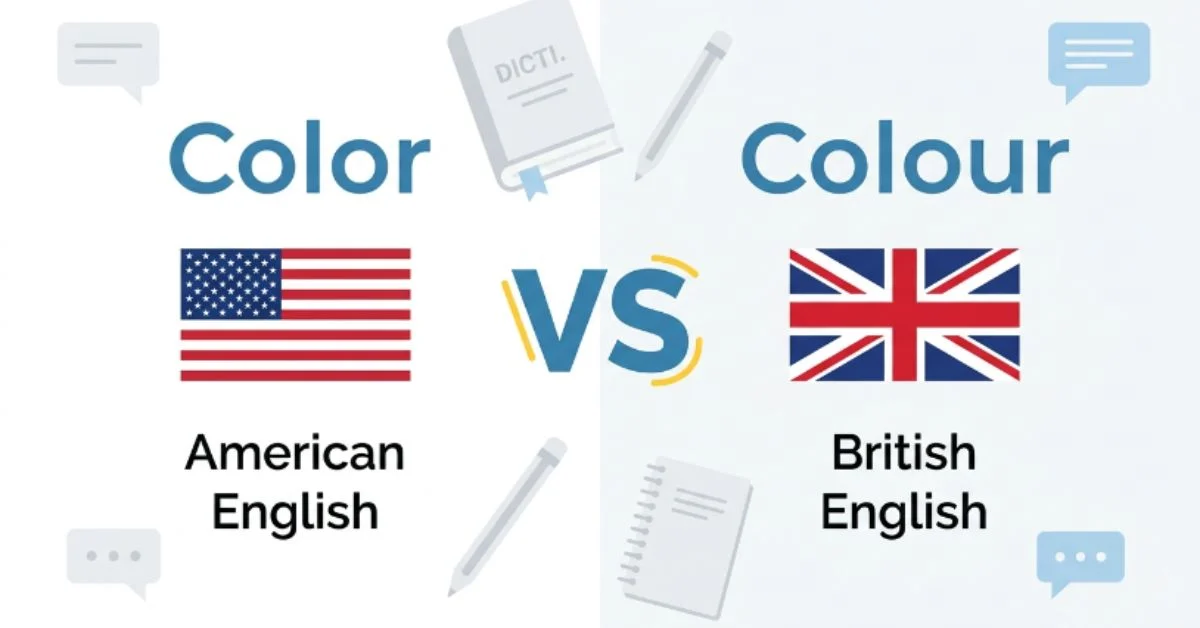
Color or colour: which spelling is actually correct? If you’ve ever paused while writing an email, school assignment, blog post, or professional document because you weren’t sure which version to use, you’re not alone.
This is one of the most common English spelling questions, confusing students, English learners, writers, bloggers, editors, and professionals worldwide. The confusion becomes even greater because both spellings appear online and seem equally correct.
So, which one should you choose? In this guide, you’ll learn the difference between color and colour, their correct spelling, pronunciation, history, regional usage, and when to use each in American English and British English.
By the end, you’ll know exactly which spelling fits your audience and write with complete confidence.
Quick Answer
The short answer is simple: both “color” and “colour” are correct.
The only difference is the variety of English you’re using.
- Color is the standard spelling in American English.
- Colour is the standard spelling in British English and most countries that follow British spelling conventions.
Both words have the same meaning, pronunciation, and grammar. They describe the appearance of something based on the light it reflects or emits.
| Spelling | Used In | Correct? |
|---|---|---|
| Color | United States | ✅ Yes |
| Colour | United Kingdom, Canada, Australia, New Zealand, Ireland, and many other English-speaking countries | ✅ Yes |
Quick Tip:
If you’re writing for an American audience, use color. If your readers follow British English, use colour.
Color or Colour: Which Spelling Is Correct?
One of the biggest misconceptions is that one spelling must be wrong. In reality, both spellings are accepted in standard English. The correct choice depends entirely on your audience and the writing style you follow.
For example, if you’re writing an article for readers in the United States, color is the preferred spelling because it’s used in American dictionaries, schools, newspapers, and businesses. On the other hand, if your audience is in the United Kingdom or follows British English, colour is the expected spelling.
This means there isn’t a universal “winner” in the color vs colour debate. Instead, you should choose the spelling that matches your readers and remain consistent throughout your writing.
Use Color When:
Choose color if you’re writing in American English or creating content primarily for readers in the United States.
Examples:
- My favorite color is blue.
- The designer selected a brighter color palette.
- This paint comes in many different colors.
Use Colour When:
Choose colour if you’re writing in British English or for readers in countries that follow British spelling conventions.
Examples:
- My favourite colour is blue.
- The autumn leaves changed colour.
- She enjoys painting with bright colours.
Can You Use Both Spellings in the Same Article?
Technically, you can, but it’s not recommended.
Mixing color and colour in the same document can make your writing look inconsistent and unprofessional. Whether you’re writing a blog post, academic paper, business report, or website content, it’s best to choose one spelling and use it consistently from beginning to end.
Consistency is especially important for:
- Academic writing
- Business communication
- Website content
- SEO articles
- Books and publications
What’s the Difference Between Color and Colour?
The difference between color and colour is purely regional spelling.
They share the same:
- Meaning
- Pronunciation
- Grammar
- Dictionary definition
- Plural form (with regional spelling)
Both words refer to the appearance of an object based on the light it reflects, absorbs, or emits. Whether you write color or colour, readers understand exactly the same thing.
Color or Colour in English
Modern English has several spelling differences between American English and British English, and color/colour is one of the most well-known examples.
Here are a few similar spelling pairs:
| American English | British English |
|---|---|
| Color | Colour |
| Favorite | Favourite |
| Honor | Honour |
| Labor | Labour |
| Neighbor | Neighbour |
| Center | Centre |
| Theater | Theatre |
| Gray | Grey |
If you’re already familiar with words like favorite/favourite or honor/honour, then color/colour follows the same spelling pattern.
Does the Meaning Change?
No.
Regardless of which spelling you choose, the meaning remains exactly the same.
For example:
- The sky is a beautiful blue color.
- The sky is a beautiful blue colour.
Both sentences describe the same idea. The only difference is whether the writer is using American English or British English.
This is why dictionaries recognize both spellings as correct—they simply belong to different regional varieties of English rather than representing different meanings.
Why Are “Color” and “Colour” Spelled Differently?
If color and colour mean exactly the same thing, why are they spelled differently?
The answer lies in the history of the English language.
The word originally comes from the Latin word color, meaning “hue” or “appearance.” It later passed into Old French as colour, and from there it entered Middle English with the “ou” spelling. For centuries, colour was the standard spelling in English.
The spelling changed in the United States during the early 1800s when American lexicographer Noah Webster introduced spelling reforms in his dictionaries. Webster believed that many English words contained unnecessary letters, so he simplified their spellings to make them easier to read, write, and print.
As a result:
- Colour became color
- Honour became honor
- Labour became labor
- Favourite became favorite
These simplified spellings became standard in American English, while British English continued using the traditional forms.
Today, both spellings are considered correct because they belong to different regional standards—not because one evolved from a mistake.
Color vs Colour History
The history of color vs colour reflects the evolution of English itself.
Before American English developed its own spelling conventions, British English used colour almost everywhere. After Noah Webster’s dictionaries were widely adopted in the United States, Americans gradually switched to color, while most other English-speaking countries kept colour.
That’s why today you’ll find:
- Color in American dictionaries, newspapers, schools, and businesses.
- Colour in British publications, Canadian schools, Australian media, and many international organizations.
Although the spellings differ, both have been accepted for more than two centuries.
Color or Colour Pronunciation
One of the most surprising facts is that color and colour are pronounced almost exactly the same.
Whether you’re speaking American English or British English, listeners won’t know which spelling you’re using because the pronunciation is nearly identical.
American Pronunciation
In American English, color is commonly pronounced as:
KUL-er
The second syllable is softer, and the “r” sound is clearly pronounced.
Example:
- I love the color of this painting.
British Pronunciation
In British English, colour is also pronounced very similarly.
Many British accents soften or drop the final “r”, making it sound closer to:
KUL-uh
Even so, the difference comes from the accent—not the spelling.
Does the “U” Change the Pronunciation?
No.
The extra “u” in colour is silent. It does not change the way the word is spoken.
This is why learners often ask about color or colour pronunciation. The answer is simple: pronounce them the same, but choose the spelling that matches your audience.
Where Is Each Spelling Used?
Knowing your audience is the easiest way to decide whether to write color or colour.
Countries That Use “Color”
Use color if you’re writing for readers in:
- United States
- American businesses
- U.S. schools and universities
- Most American publishers
Countries That Use “Colour”
Use colour if you’re writing for readers in:
- United Kingdom
- Canada
- Australia
- New Zealand
- Ireland
- South Africa
- India
- Many countries that follow British English
Color or Colour in Europe
People often search for “color or colour in Europe.”
There isn’t one single European spelling because different countries follow different English standards. However, when English is taught or used in most European schools, universities, and organizations, British English is generally preferred. That means colour is more common than color in European English-language writing.
If you’re creating content specifically for a European audience, colour is usually the safer choice unless you’re targeting American readers.
Color vs Colour Comparison Table
| Feature | Color | Colour |
|---|---|---|
| Correct spelling | ✅ Yes | ✅ Yes |
| American English | ✅ Standard | ❌ No |
| British English | ❌ No | ✅ Standard |
| Canadian English | Sometimes | ✅ More common |
| Australian English | ❌ No | ✅ Standard |
| Meaning | Same | Same |
| Pronunciation | Same | Same |
| Grammar | Same | Same |
| Formal writing | ✅ Yes | ✅ Yes |
Plural of Color and Colour
Another common question is about the plural of colour.
Fortunately, the rule is simple.
| Singular | Plural |
|---|---|
| Color | Colors |
| Colour | Colours |
The grammar doesn’t change—only the spelling follows American or British English.
Examples
American English
- The rainbow has many colors.
- Bright colors make the design stand out.
- Children enjoy using different colors when drawing.
British English
- The rainbow has many colours.
- Autumn colours are beautiful.
- She mixed several colours before starting the painting.
Whether you write colors or colours, both forms are grammatically correct within their respective varieties of English.
Which Spelling Should You Use?
Now that you know both spellings are correct, the next question is: Which one should you use?
The answer depends on your audience, not your personal preference.
If you’re writing for readers in the United States, use color because it’s the standard spelling in American English. If your audience is in the United Kingdom, Canada, Australia, New Zealand, or other countries that follow British English, use colour.
For Academic Writing
Follow your school’s or university’s style guide.
- American institutions usually expect color.
- British institutions usually expect colour.
Using the preferred regional spelling shows attention to detail and keeps your writing consistent.
For Business and Professional Writing
Many companies have an internal style guide.
For example:
- A U.S.-based brand should consistently use color across its website, emails, and marketing materials.
- A UK-based company should consistently use colour.
Consistency helps build a professional brand identity.
For SEO and Website Content
If you’re creating content for search engines, think about your target audience before choosing a spelling.
- Targeting U.S. readers? Use color throughout the page.
- Targeting UK readers? Use colour throughout the page.
- Serving an international audience? Pick one spelling based on your primary audience and stay consistent.
Using one spelling consistently is generally better than mixing both versions throughout the same article. If you’re discussing the difference—as in this guide—it’s natural to use both because you’re comparing them.
Common Mistakes to Avoid
Although color and colour are both correct, writers often make mistakes when using them.
Mixing Both Spellings
One of the most common errors is writing:
- ❌ The color of the flowers is my favourite colour.
While this sentence isn’t grammatically wrong, mixing American and British spellings can look inconsistent unless you’re intentionally comparing the two.
Instead, choose one style:
American English
- ✅ My favorite color is green.
British English
- ✅ My favourite colour is green.
Choosing the Wrong Spelling for Your Audience
Imagine writing a website for a British company while using color throughout the content. Readers may notice the inconsistency, and it can make the writing feel less natural.
Always consider who will be reading your content before deciding which spelling to use.
Assuming One Spelling Is Incorrect
Many English learners believe colour is wrong because they learned color, or vice versa.
The truth is simple:
- Color is correct.
- Colour is also correct.
The only difference is the regional variety of English.
FAQs
Is it color or colour?
Both spellings are correct. Color is used in American English, while colour is used in British English and many other English-speaking countries.
What is the difference between color and colour?
There is no difference in meaning, pronunciation, or grammar. The only difference is regional spelling.
Why does British English use “colour”?
British English kept the traditional spelling influenced by French and Middle English, while American English later adopted the simplified spelling color.
Is color or colour pronounced differently?
No. Both words are pronounced almost the same. Any small difference comes from the speaker’s accent rather than the spelling.
Which spelling is used in Europe?
When English is used in many European schools, universities, and organizations, British English is generally preferred. As a result, colour is more commonly used than color.
What is the plural of colour?
The plural of colour is colours. In American English, the plural of color is colors.
Can I use both spellings in the same article?
It’s best to avoid mixing them unless you’re specifically comparing color and colour. Choose one spelling and use it consistently throughout your writing.
Is one spelling more correct than the other?
No. Both spellings are officially accepted. The correct choice depends on whether you’re writing in American English or British English.
Final Thoughts
The debate over color or colour isn’t about right versus wrong—it’s about choosing the spelling that matches your audience. Color is the standard spelling in American English, while colour is preferred in British English and many other parts of the world.
Since both words have the same meaning, pronunciation, and grammatical function, you don’t need to worry about changing your message. Instead, focus on writing consistently. Whether you’re creating a blog post, academic paper, business document, or website content, sticking to one spelling style will make your writing look more polished and professional.
Whenever you’re unsure, remember this simple rule:
American English uses “color.” British English uses “colour.” Both are correct—the best choice is the one your readers expect.
Read More Blogs: