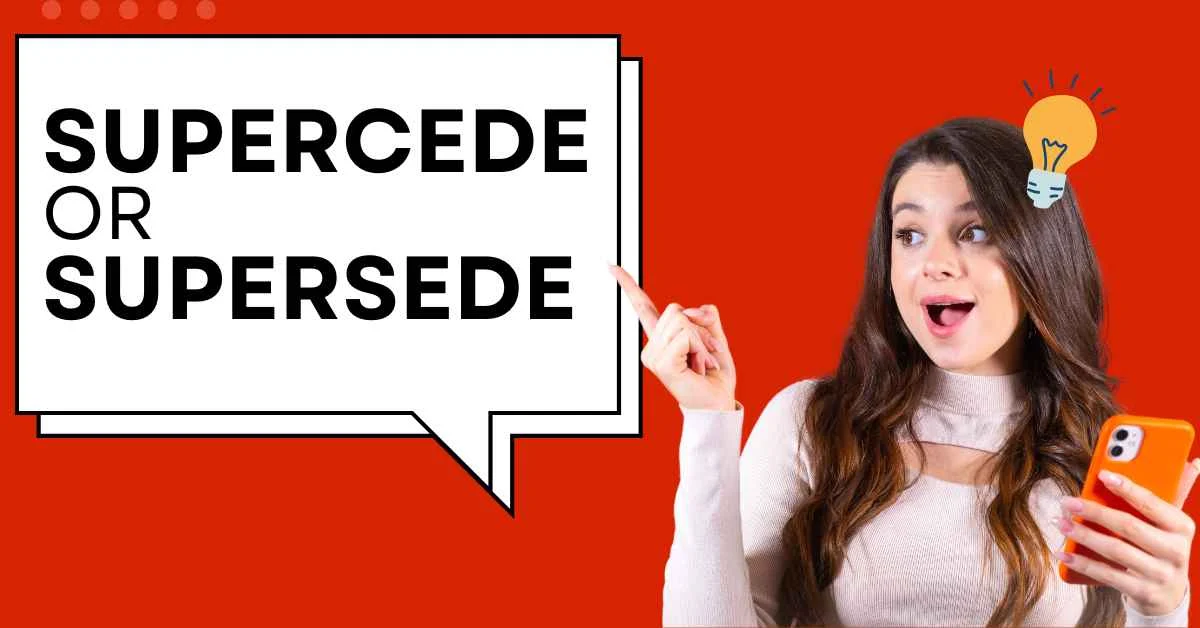
Supersede is the correct spelling. Supercede is a common misspelling and is not recognized by major dictionaries, including Merriam-Webster, Oxford, and Cambridge.
The confusion happens because many English verbs end in -cede, but supersede is a well-known exception that ends in -sede.
Quick Answer Table
| Correct | Incorrect | Why |
|---|---|---|
| supersede | supercede | The word is an exception and ends in -sede, not -cede. |
| superseded | superceded | The past tense keeps the original spelling. |
| superseding | superceding | The base word is supersede. |
Why People Make This Mistake
At first glance, supercede looks perfectly reasonable.
That’s because English has several common verbs ending in -cede, including:
- precede
- concede
- recede
- intercede
- secede
After seeing this pattern repeatedly, many people naturally assume supercede must be correct as well.
However, supersede doesn’t belong to that spelling family.
It follows a different historical pattern, which is why it ends in -sede instead of -cede.
Professional editors frequently spot this mistake in legal documents, business reports, academic papers, software documentation, and workplace emails. Even experienced writers occasionally type supercede because their brains automatically apply the more familiar -cede ending.
The mistake isn’t caused by pronunciation. Both spellings sound almost identical. It’s a pattern-recognition error rather than a speaking error.
The Rule Behind It
Unlike most words that sound similar, supersede is simply an exception.
There isn’t a modern spelling rule that explains the -sede ending.
Instead, it’s the historical spelling that English has preserved for centuries.
That means the correct forms are always:
- supersede
- supersedes
- superseded
- superseding
Never write:
- ❌ supercede
- ❌ superceded
- ❌ superceding
When you learn this one exception, you’ll avoid an error that appears surprisingly often in professional writing.
Why Is Supersede an Exception?
Most English verbs ending with the “seed” sound are spelled -cede.
For example:
| Word | Meaning |
|---|---|
| precede | come before |
| concede | admit or acknowledge |
| recede | move back |
| intercede | act on someone else’s behalf |
| secede | withdraw from a group |
Then comes one unusual word.
| Word | Meaning |
|---|---|
| supersede | replace or take the place of |
It’s the only commonly used English verb in this group that ends with -sede.
That’s why spell-checkers often correct supercede immediately.
Word Origin
The spelling becomes much easier to understand when you know where the word came from.
Supersede comes from the Latin verb supersedere, meaning to sit above, to refrain from, or to replace.
Unlike precede, concede, and recede, which come from a different Latin root, supersede developed from supersedere, preserving the -sede ending.
Although modern English pronunciation makes these words sound alike, their histories are different.
That’s why supersede keeps its unusual spelling.
Meaning of Supersede
Supersede means:
- to replace something older
- to take the place of something
- to make something no longer necessary
- to become the new standard
Examples:
- The new policy supersedes the previous version.
- Digital payments have largely superseded paper checks.
- This agreement supersedes all earlier contracts.
Real-Life Examples
Business
The updated policy supersedes all previous guidelines.
Legal Writing
This contract supersedes every earlier agreement between the parties.
Technology
The latest software version supersedes the older release.
Government
The new regulation supersedes legislation introduced in 2018.
Education
The revised syllabus supersedes the previous curriculum.
Everyday Conversation
New habits often supersede old routines over time.
Incorrect vs Correct
❌ The revised document supercedes the original contract.
✅ The revised document supersedes the original contract.
❌ This update has superceded the old version.
✅ This update has superseded the old version.
Common Places This Mistake Appears
Business Emails
Professionals often use the word when discussing updated procedures.
Example: This policy supercedes the previous version.
Legal Documents
Contracts frequently state that one agreement replaces another.
Example: This contract supercedes all earlier agreements.
Software Documentation
Developers use the word when releasing new versions.
Example: Version 4.0 supercedes Version 3.5.
Academic Writing
Researchers often describe one theory replacing another.
Example: The new model supercedes the earlier hypothesis.
Government Notices
Official publications commonly announce revised regulations.
Example: The updated guidance supercedes the 2024 policy.
Workplace Reports
Internal documents often reference updated procedures.
Example: The revised process supercedes the previous workflow.
Technical Manuals
Manuals frequently indicate replacement instructions.
Example: This section supercedes the earlier installation guide.
Blog Posts
Writers may rely on familiar spelling patterns instead of checking the dictionary.
Example: The latest update supercedes the old recommendation.
Online Forums
Informal discussions often contain this spelling mistake.
Example: Does this patch supercede the earlier release?
Tip: Every example above should use supersede, supersedes, or superseded, depending on the sentence.
Memory Trick
Here’s an easy way to remember it:
SuperSede has two S’s because it “Steps in” to replace something.
Both Supersede and Step in begin with S, reminding you that this word keeps the S, not a C.
Another simple trick is this:
Every word in the -cede family follows the rule—except supersede.
When in doubt, remember that supersede is the exception.
Mini Quiz
1. Which spelling is correct?
A. Supercede
B. Supersede
2. Fill in the blank.
The revised agreement __ all previous versions.
3. Which sentence is correct?
A. This software supercedes the old release.
B. This software supersedes the old release.
4. True or False
Supercede is accepted by major English dictionaries.
Answer Key
- ✅ B
- ✅ supersedes
- ✅ B
- ✅ False
FAQs
Is supercede a real word?
No. Supercede is a common misspelling and is not recognized by major dictionaries. The correct spelling is supersede.
Which is correct: supercede or supersede?
Supersede is correct. It is the standard spelling in American, British, Canadian, and Australian English.
Why is it supersede instead of supercede?
Although many English verbs end in -cede, supersede comes from a different Latin root (supersedere). That’s why it keeps the -sede ending.
Is supersede an exception to the -cede rule?
Yes. Supersede is the only commonly used English verb ending in -sede. Words like precede, concede, and recede all end in -cede.
What does supersede mean?
Supersede means to replace, to take the place of, or to make something no longer necessary.
Is supercede correct in British English?
No. British English also uses supersede. The spelling supercede is incorrect in all standard varieties of English.
Does Grammarly accept supercede?
No. Grammarly flags supercede as a spelling mistake and recommends supersede.
Does Microsoft Word underline supercede?
Yes. Microsoft Word normally marks supercede as incorrect and suggests supersede.
What is the past tense of supersede?
The past tense is superseded.
Example: The updated policy superseded the previous one.
What is the past participle of supersede?
The past participle is also superseded.
How do you pronounce supersede?
It is pronounced soo-per-SEED or SOO-pər-seed, depending on the accent. Both American and British pronunciations keep the same spelling.
Is superseding spelled with a c?
No. The correct present participle is superseding, which keeps the s from the base word.
Why do so many people write supercede?
People naturally copy the familiar -cede pattern found in words like precede, concede, and recede, even though supersede is the exception.
Is supersede used in legal writing?
Yes. It’s commonly used in legal, business, government, and technical writing to indicate that one document or policy replaces another.
How can I remember the correct spelling?
Remember this phrase:
Supersede is the exception—it keeps the second S.
If you think of it as the word that stands apart from the -cede group, you’ll be more likely to remember the correct spelling.
Related Mistakes You Might Also See
If this mistake happened because of an irregular spelling pattern, these guides may also help:
- separate or seperate
- occurred or occured
- receive or recieve
- weird or wierd
- privilege or privelege
- maintenance or maintainance
- embarrass or embarass
- existence or existance
- independent or independant
- accommodate or accomodate
- judgment or judgement
- pronunciation or pronounciation
These words are frequently misspelled because they don’t follow the spelling pattern many writers expect.
Conclusion
The correct spelling is supersede. Although supercede may look logical because of words like precede and concede, it isn’t accepted in standard English.
A simple way to remember the difference is that supersede is the famous exception. It keeps the -sede ending because of its historical origin, not because of the common -cede pattern.
If irregular spelling patterns often trip you up, you may also want to review words like receive, separate, and accommodate, which are commonly misspelled for similar reasons.
Related Blogs: