Have you ever stopped while writing and wondered whether you should use afterward or afterwards? You are not alone.
Many students, writers, professionals, and English learners get confused by these two words because they look almost identical and have the same meaning.
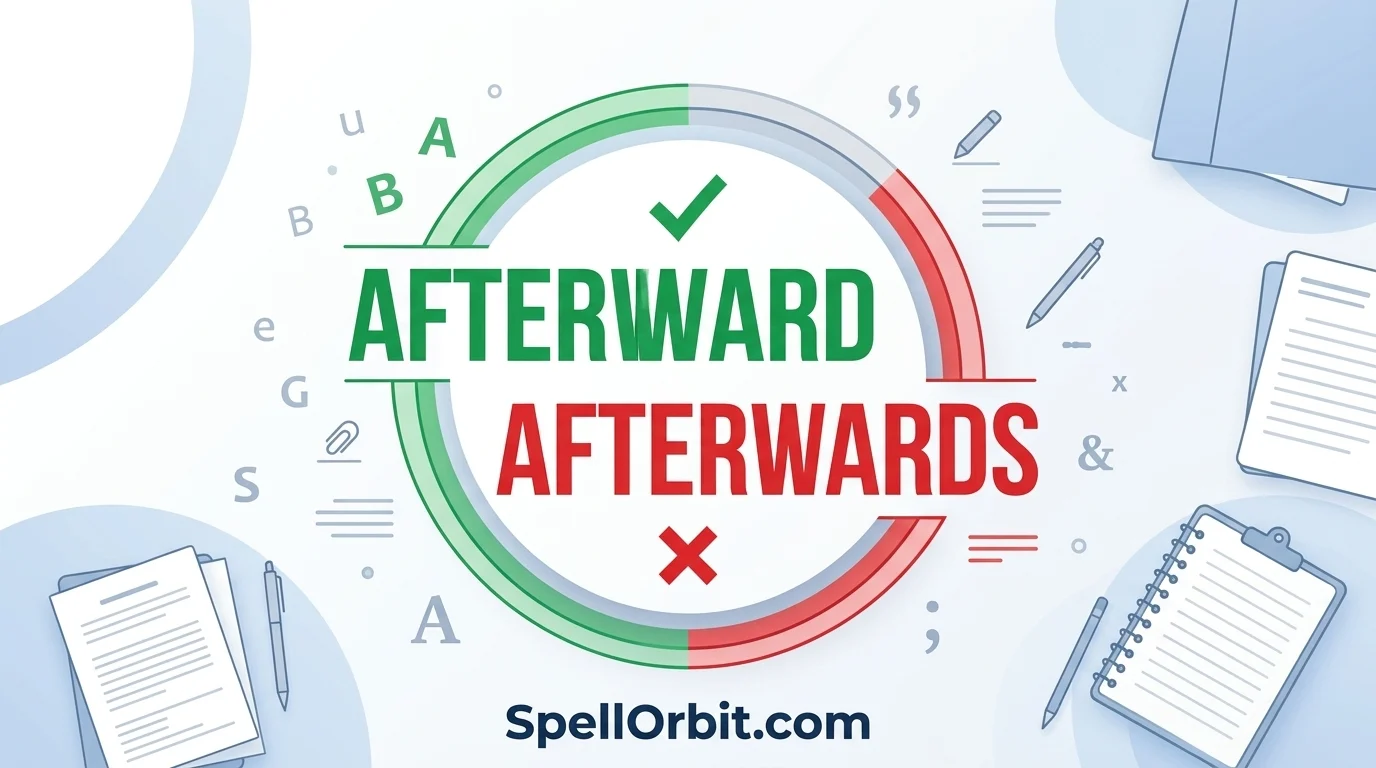
The good news is that both forms are correct. The difference mainly comes down to regional preference.
In this guide, you will learn the meaning of each word, when to use them, how American English and British English differ, and which option works best for your audience.
By the end, you will know exactly which form to choose in any situation.
Quick Answer
Afterward and afterwards mean the same thing. Both are adverbs that refer to something happening later or at a later time.
The main difference is regional usage:
- Afterward is more common in American English.
- Afterwards is more common in British English.
Quick Example
- We went out for dinner, and afterward we watched a movie.
- We went out for dinner, and afterwards we watched a movie.
Both sentences are correct.
What Do Afterward and Afterwards Mean?
Both words function as time expressions and temporal adverbs. They help indicate that one event happened after another.
Common Meanings
The words can mean:
- Later
- Subsequently
- Thereafter
- Following that
- At a later time
- Next
- Eventually
Simple Usage Examples
- She finished her presentation and afterward answered questions.
- He completed the project and afterwards took a short vacation.
- We met for coffee and afterwards went shopping.
- The meeting ended. Afterward, everyone received a summary email.
In each example, the adverb shows the sequence of events.
The Origin of Afterward and Afterwards
Understanding the history of these words helps explain why both forms still exist today.
Word History
The word comes from the combination of:
- After
- Ward
Historically, -ward indicated direction or movement. Over time, English speakers developed two versions:
- Afterward
- Afterwards
Both forms became accepted in Standard English.
Why the Confusion Happens
The confusion occurs because English contains many similar pairs:
- Toward vs Towards
- Forward vs Forwards
- Backward vs Backwards
- Upward vs Upwards
- Downward vs Downwards
In each case, both forms are generally correct, but regional preferences often determine which version appears more frequently.
British English vs American English
Regional variation is the main reason people search for this grammar comparison.
Comparison Table
| Feature | Afterward | Afterwards |
|---|---|---|
| Meaning | Later | Later |
| Grammar | Correct | Correct |
| American English | Preferred | Less common |
| British English | Acceptable | Preferred |
| Canadian English | Common | Common |
| Australian English | Used | More common |
American English Usage
Writers in the United States typically choose afterward.
Examples:
- The team celebrated afterward.
- She called me afterward to discuss the results.
British English Usage
Writers in the United Kingdom often choose afterwards.
Examples:
- We visited the museum and afterwards had lunch.
- He explained the process and afterwards answered questions.
Afterward vs Afterwards vs Similar Words
Many learners compare these words with other transition words and linking expressions.
Comparison Table
| Word | Meaning |
|---|---|
| Afterward | Later |
| Afterwards | Later |
| Subsequently | After something else |
| Thereafter | Following that |
| Then | Next |
| Eventually | In the end |
| Meanwhile | During the same time |
| Previously | Before now |
When to Use Each One
- Use afterward/afterwards for everyday writing.
- Use subsequently in formal or academic writing.
- Use thereafter in legal or professional documents.
- Use then in casual conversation.
Which Form Should You Use?
The best choice depends on your audience and writing style.
US Audience
Choose afterward.
American readers see this version more often, so it feels natural and familiar.
UK Audience
Choose afterwards.
British publications commonly use the version ending in s.
International Writing
Either form works. However, consistency matters more than the specific choice.
Academic Writing
Follow the style guide required by your institution.
Popular style guides include:
- AP Style
- Chicago Manual of Style
- MLA Style
- APA Style
Business Writing
Choose one form and use it consistently throughout reports, emails, and professional communication.
Common Mistakes with Afterward and Afterwards
Although both words are correct, writers still make mistakes.
Frequent Errors
Mixing Styles
Incorrect:
- We met afterward and afterwards went home.
Correct:
- We met afterward and went home.
Using Them as Adjectives
Incorrect:
- The afterward meeting was productive.
Correct:
- The meeting afterward was productive.
Inconsistent Writing
Incorrect:
- We met afterward. Afterwards, we had dinner.
Correct:
- We met afterward. Afterward, we had dinner.
Corrected Examples
| Incorrect | Correct |
|---|---|
| The afterward report | The report afterward |
| We talked and afterward afterwards left | We talked and afterward left |
| Afterwards she called and afterward emailed | Choose one style consistently |
Afterward and Afterwards in Everyday Writing
These words appear in many types of written English.
Emails
- Please review the document. Afterward, send your feedback.
Social Media
- Finished my workout. Afterwards, I treated myself to coffee.
News Writing
- The committee met Monday. Afterward, officials released a statement.
School Writing
- The experiment ended. Afterwards, students recorded observations.
Business Writing
- The training session concluded. Afterward, employees completed evaluations.
Blog Writing
Content writers often use these adverbs as transition words to improve sentence flow and readability.
Why Transition Words Matter
Words like afterward, afterwards, therefore, meanwhile, consequently, and subsequently improve cohesion and coherence.
Benefits include:
- Better sentence flow
- Improved readability
- Stronger writing clarity
- Better reading comprehension
- More professional communication
As a result, editors and proofreaders often recommend using transition words naturally throughout content.
Google Trends and Search Popularity
Popular Countries
Search interest is strongest in:
- United States
- United Kingdom
- Canada
- Australia
- India
Why People Search Afterward or Afterwards
People usually want to know:
- Which spelling is correct
- Whether one form is wrong
- Which version Americans use
- Which version British writers prefer
- How to improve writing accuracy
- How style guides treat the words
Related Grammar Rules
Similar Word Pairs
These comparisons follow similar regional patterns:
- Toward vs Towards
- Forward vs Forwards
- Backward vs Backwards
- Upward vs Upwards
- Downward vs Downwards
- Amid vs Amidst
- Among vs Amongst
- While vs Whilst
Helpful Grammar Tips
- Both forms are grammatically correct.
- Choose based on your audience.
- Maintain style consistency.
- Follow editorial standards when required.
- Use transition words naturally.
FAQs
Is afterward correct?
Yes. Afterward is completely correct and commonly used in American English.
Is afterwards correct?
Yes. Afterwards is completely correct and commonly used in British English.
Which is more common in the United States?
American writers generally prefer afterward.
Which is more common in the United Kingdom?
British writers generally prefer afterwards.
Do afterward and afterwards have different meanings?
No. They mean exactly the same thing.
Can I use them interchangeably?
Yes. However, it is best to remain consistent within the same document.
Is afterward formal or informal?
It works in both formal and informal writing.
What is the easiest rule to remember?
Use afterward for American audiences and afterwards for British audiences.
What is the difference between afterward and afterwards?
There is no difference in meaning. Both words mean “later” or “at a later time.” American English usually prefers afterward, while British English commonly uses afterwards.
Conclusion
The debate over afterward or afterwards is simpler than many people think. Both words are correct, both mean “later,” and both appear in standard English.
The main difference lies in regional preference. American English usually favors afterward, while British English generally prefers afterwards.
Therefore, the best choice depends on your audience. Most importantly, stay consistent throughout your writing.
Whether you are writing emails, academic papers, business reports, blog posts, or social media content, using one form consistently will make your writing clearer, more professional, and easier to read.