Have you ever described someone as a little too curious and then paused to wonder whether you should write nosey or nosy? You are not alone.
Many English learners, students, writers, and professionals get confused by these two spellings because both appear in dictionaries and online articles.
The good news is that both forms exist, but one is more widely preferred in modern English.
In this guide, you will learn the difference between nosey and nosy, their meanings, usage examples, dictionary preferences, and when each spelling is appropriate.
By the end, you will know exactly which version to use in your writing.
Quick Answer
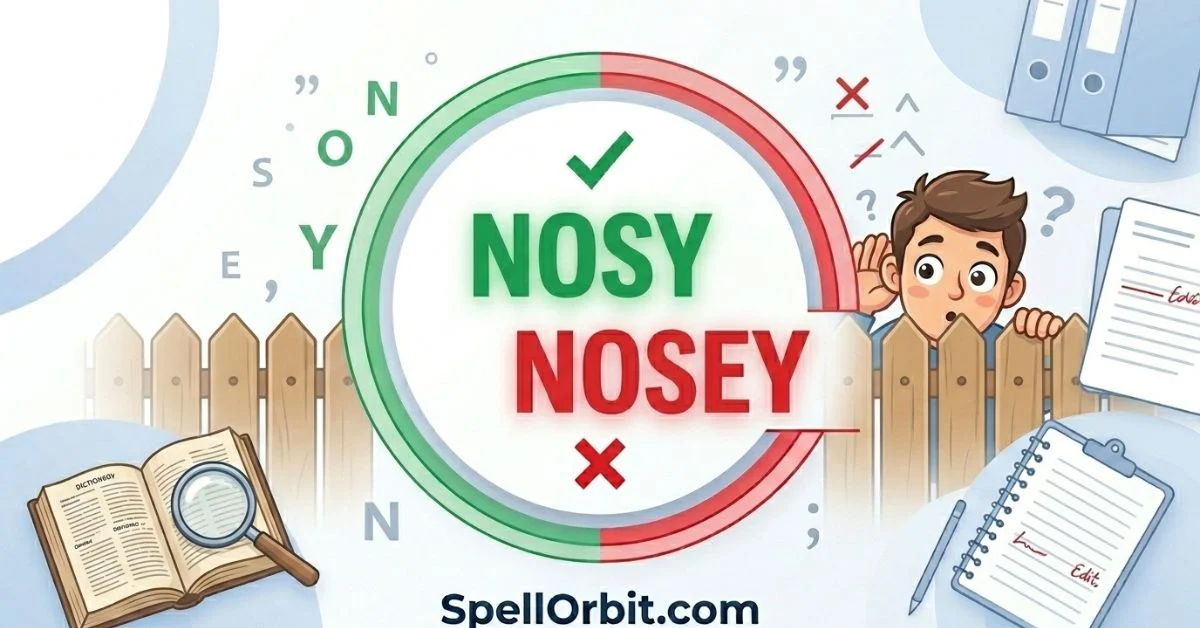
Nosy is the preferred and more common spelling in modern English.
Nosey is an alternative spelling that some dictionaries recognize, but it appears less frequently in contemporary writing.
Both words describe a person who is overly curious about other people’s private affairs.
Correct Example
- My neighbor is so nosy that she always asks about everyone’s plans.
Also Acceptable
- My neighbor is so nosey that she always asks about everyone’s plans.
A nosy person often wants information that others would rather keep private.
Common Meanings
- Overly curious
- Prying into personal matters
- Meddlesome
- Intrusive
- Snooping
- Interfering
- Overinvolved in other people’s affairs
Simple Usage Examples
- The reporter became nosy and asked several personal questions.
- My coworker is nosy and likes to know everything happening in the office.
- Some people appear friendly at first but become nosy over time.
- The child grew curious without becoming nosy.
Is Nosey a Real Word?
Yes, nosey is a real word.
Several dictionaries recognize it as a spelling variant of nosy. However, most modern publications, editors, and style guides prefer nosy.
As a result, writers usually choose nosy for consistency and readability.
Why Does Nosey Exist?
The spelling likely developed from the noun nose because the word originally suggested someone “sticking their nose” into other people’s business.
Over time, both spellings appeared in English, although nosy became more common.
The Origin of Nosy and Nosey
The history of this word helps explain why two spellings exist.
Word History
The adjective developed from the idea of a person being too interested in other people’s affairs. English speakers connected this behavior with “putting one’s nose where it does not belong.”
Consequently, spellings such as nosey appeared naturally.
Eventually, nosy became the dominant spelling in newspapers, books, magazines, and educational materials.
Why the Confusion Happens
People become confused because:
- Both spellings appear in dictionaries.
- Both have the same meaning.
- Different publications use different style preferences.
- Online sources often show both versions.
Therefore, many writers assume one spelling must be wrong, even though both are accepted.
Nosey vs Nosy: What’s the Difference?
The meaning remains exactly the same.
The difference lies mainly in usage frequency and editorial preference.
Comparison Table
| Feature | Nosy | Nosey |
|---|---|---|
| Meaning | Overly curious | Overly curious |
| Grammar | Correct | Correct |
| Modern Usage | More common | Less common |
| Preferred by Editors | Yes | Usually No |
| Dictionary Recognition | Yes | Yes |
| Professional Writing | Recommended | Less common |
Which Spelling Is More Common?
Most writers, teachers, editors, and proofreaders prefer nosy.
Therefore, if you are unsure, choose nosy.
Nosy vs Similar Personality Traits
Many people confuse nosiness with other personality characteristics. However, these terms do not always mean the same thing.
Curious vs Nosy
A curious person wants to learn and understand.
A nosy person wants private information that may not concern them.
Inquisitive vs Nosy
An inquisitive person asks thoughtful questions to gain knowledge.
A nosy person asks questions that may invade personal privacy.
Observant vs Nosy
An observant person notices details.
A nosy person actively seeks private information.
Snoopy vs Nosy
These words are very similar. Both describe someone who investigates other people’s affairs without permission.
Synonyms of Nosy
Several words share a similar meaning.
Common Synonyms
- Busybody
- Meddler
- Snoop
- Gossip
- Interferer
- Prying person
- Intruder
- Eavesdropper
- Meddlesome person
- Rubbernecker
Example Sentences
- The busybody knew everyone’s secrets.
- The snoop searched through private documents.
- The gossip spread rumors around the neighborhood.
Antonyms of Nosy
These words express the opposite idea.
Common Antonyms
- Reserved
- Discreet
- Respectful
- Considerate
- Private
- Detached
- Independent
- Nonintrusive
Example Sentences
- She remained discreet during the conversation.
- A respectful colleague avoids personal questions.
- Private individuals rarely discuss personal matters.
Nosy in Everyday Writing
The word appears in many forms of communication.
Social Media
People often use it humorously.
Example:
- I am not nosy; I am just curious.
Family Conversations
Example:
- My aunt can be a little nosy sometimes.
Workplace Communication
Example:
- Employees should avoid appearing nosy about coworkers’ personal lives.
Creative Writing
Authors often use the word when describing character traits.
Example:
- The nosy neighbor watched everything from her window.
Online Discussions
The term frequently appears in discussions about privacy, boundaries, and social etiquette.
Why Privacy Matters
The word nosy often appears in conversations about personal privacy.
Healthy relationships require respect for boundaries.
Although curiosity is natural, repeatedly asking intrusive questions can make others uncomfortable.
Therefore, understanding the difference between curiosity and nosiness improves interpersonal communication and social etiquette.
Dictionary and Style Guide Preferences
Most major dictionaries recognize both spellings.
Dictionary Recognition
Common references include:
- Merriam-Webster
- Cambridge Dictionary
- Oxford English Dictionary
- Collins Dictionary
- Dictionary.com
Editorial Preferences
Many professional editors and publishing guidelines prefer nosy because it is more common in modern English.
Consequently, writers often choose nosy in blogs, articles, academic papers, and business communication.
Common Mistakes with Nosy and Nosey
Frequent Errors
Assuming Nosey Is Incorrect
Many people think nosey is wrong. However, dictionaries recognize it as an accepted variant.
Mixing Spellings
Choose one spelling and use it consistently throughout your document.
Confusing Curious with Nosy
Curiosity is generally positive. Nosiness usually carries a negative meaning.
Corrected Examples
| Incorrect Understanding | Correct Understanding |
|---|---|
| Nosey is wrong | Nosey is acceptable but less common |
| Curious and nosy are identical | They have different meanings |
| Only one spelling exists | Both spellings exist |
Related Word Comparisons
If you enjoy grammar comparisons, you may also encounter:
- Toward vs Towards
- Forward vs Forwards
- Backward vs Backwards
- Afterward vs Afterwards
- Amid vs Amidst
- Among vs Amongst
- While vs Whilst
Like nosey and nosy, these word pairs often involve usage preferences rather than strict right-or-wrong rules.
FAQs
Is nosy the correct spelling?
Yes. Nosy is the preferred spelling in modern English.
Is nosey a real word?
Yes. Nosey is a recognized spelling variant of nosy.
Which spelling is more common?
Nosy is considerably more common in modern writing.
What does nosy mean?
It describes someone who is overly curious about other people’s private affairs.
Can nosey and nosy be used interchangeably?
Yes. They have the same meaning.
Is nosy a negative word?
Usually yes. It often suggests intrusive or unwanted curiosity.
What is the difference between curious and nosy?
Curious people seek knowledge. Nosy people seek private information.
Which spelling should I use in professional writing?
Most editors recommend using nosy.
Which is correct: nosey or nosy?
Both spellings are correct, but nosy is the preferred spelling in modern English. It describes someone who is overly curious, intrusive, or interested in other people’s private matters.
What Does Nosy Mean?
The word nosy is an adjective used to describe a person who asks too many personal questions or interferes in matters that do not concern them.
Conclusion
The answer to the nosey or nosy debate is straightforward. Both spellings exist and both carry the same meaning.
However, nosy has become the preferred choice in modern English, especially in professional writing, publishing, and online content.
If you want the safest option, choose nosy. Nevertheless, if you encounter nosey, remember that it is not wrong.
Understanding the difference helps you write with greater accuracy, improve your vocabulary, and communicate more clearly in everyday situations.