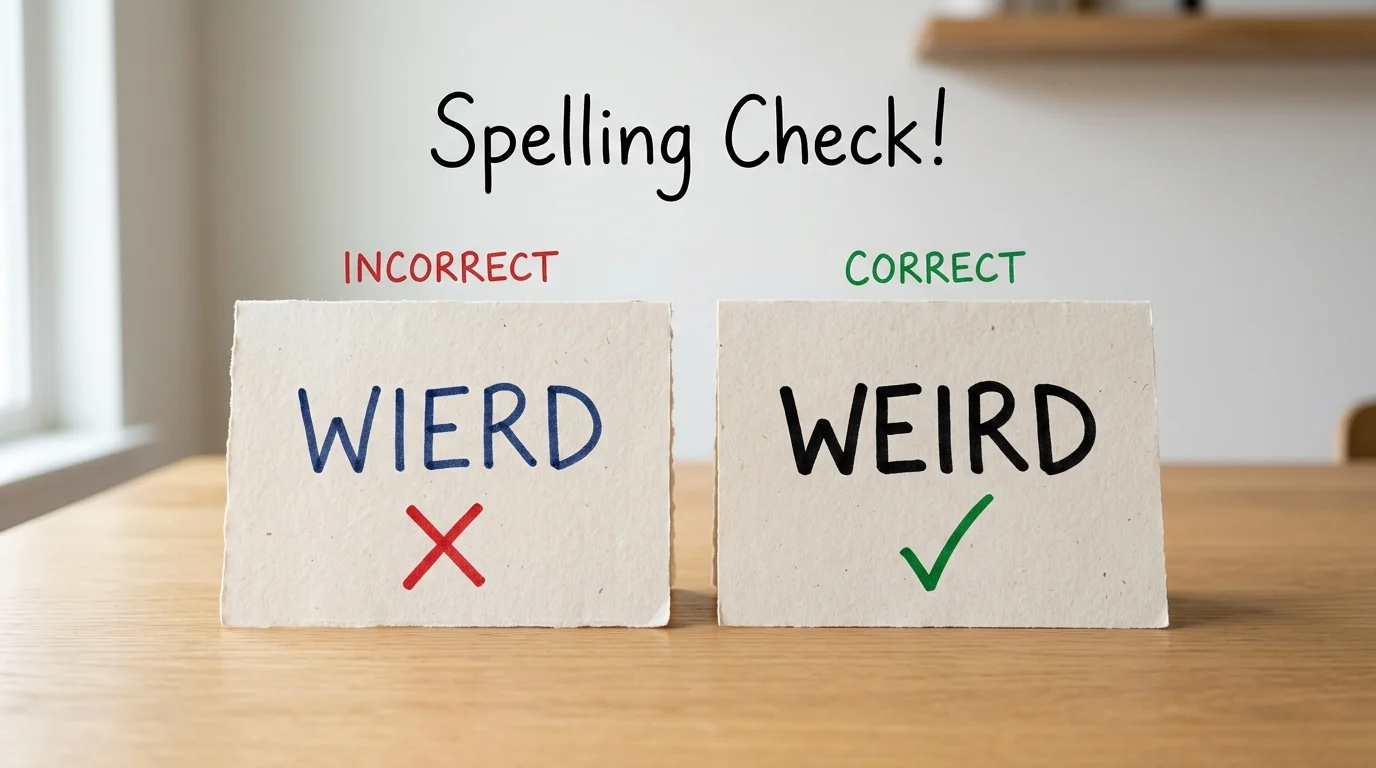
If you’re wondering whether the correct spelling is weird or wierd, the answer is simple: weird is the only correct spelling. Wierd is a common misspelling caused by the confusing “I before E except after C” rule, which doesn’t apply to every English word.
This mistake is common among students, writers, bloggers, and English learners because the word breaks a familiar spelling pattern. In this guide, you’ll learn the correct spelling, meaning, pronunciation, origin, grammar rules, and real-life examples of weird.
We’ll also explain why the confusion exists, compare British and American English usage, share easy memory tricks, and help you avoid this common spelling mistake with confidence.
Quick Answer
The correct spelling is weird.
Wierd is an incorrect spelling and should always be corrected to weird.
| Spelling | Correct? | Meaning |
|---|---|---|
| Weird | ✅ Yes | Strange, unusual, odd, or unexpected |
| Wierd | ❌ No | Incorrect spelling of weird |
Examples
✅ That was a weird dream.
✅ He gave me a weird look.
❌ That was a wierd dream.
Whenever you are unsure, remember that weird is the spelling found in every major dictionary and used in professional writing around the world.
What Does Weird Mean?
The word weird is an adjective that describes something strange, unusual, odd, unexpected, or difficult to explain.
Depending on the situation, weird can describe:
- Strange behavior
- Unusual events
- Odd people
- Bizarre situations
- Unexpected feelings
- Peculiar sounds
- Uncommon experiences
Example Sentences
- That movie had a weird ending.
- I heard a weird noise outside.
Common Synonyms of Weird
Instead of repeating weird, you can also use:
- strange
- odd
- unusual
Opposites of Weird
Words with the opposite meaning include:
- normal
- ordinary
Why Do People Spell Weird as Wierd?
The confusion comes from the famous spelling rhyme:
“I before E except after C.”
Many learners remember this rule and naturally write wierd because the letters i and e seem to follow it.
However, weird is one of the many exceptions to this guideline.
English contains hundreds of words that do not follow the rhyme perfectly, so relying on it alone often leads to spelling mistakes.
Because weird is used frequently in everyday conversation, typing quickly can also cause a simple keyboard error or typo.
The Origin of Weird
The word weird has an interesting history that goes back hundreds of years.
It comes from the Old English word wyrd, which meant fate, destiny, or the power that controls future events. In early English literature, wyrd referred to the force that determined a person’s future rather than something strange or unusual.
Over time, the meaning changed.
People began connecting the word with supernatural events, mysterious powers, and things beyond normal understanding. By the sixteenth and seventeenth centuries, weird was often used to describe something connected with magic, destiny, or the unknown.
Its meaning shifted again until it came to describe anything that seemed odd, unusual, bizarre, or unexpected.
Today, the modern meaning has little to do with fate. Instead, it usually describes something that feels different from what people expect.
Why Doesn’t Weird Follow Normal Spelling Rules?
English spelling developed from many languages, including Old English, French, Latin, and Norse languages.
As words changed over centuries, many kept their historical spellings instead of following simple pronunciation rules.
That is why weird appears to break the familiar “I before E except after C” guideline.
In reality, the rhyme has many exceptions, including words such as:
- weird
- either
- neither
- foreign
- leisure
- protein
- seize
For this reason, it is better to memorize weird as a complete word instead of depending only on spelling rules.
How to Pronounce Weird
The correct pronunciation is:
/wɪrd/
It sounds like:
“weerd.”
Although the pronunciation is simple, many people still reverse the letters while writing because the sound does not clearly show the order of e and i.
Easy Trick to Remember the Spelling
A simple mnemonic is:
WEird starts with WE.
Since the word begins with WE, write the e before the i.
Another easy reminder is:
- WE are spelling WEird correctly.
Using this memory trick makes it much easier to avoid writing wierd.
British English vs American English Spelling
Unlike many English words, weird has exactly the same spelling in both British English and American English.
Whether you are writing in the United States, the United Kingdom, Canada, Australia, New Zealand, or any other English-speaking country, weird is always the correct spelling.
The misspelling wierd is not accepted in either variety of English.
British vs American Comparison
| Feature | British English | American English |
|---|---|---|
| Correct spelling | Weird | Weird |
| Incorrect spelling | Wierd | Wierd |
| Meaning | Strange or unusual | Strange or unusual |
| Pronunciation | Same | Same |
| Accepted in dictionaries | ✅ Yes | ✅ Yes |
Unlike pairs such as colour/color, travelled/traveled, or judgement/judgment, there is no regional spelling difference for weird. If you see wierd, it is simply a spelling mistake rather than a British or American variation.
Which Spelling Should You Use?
The answer is simple: always use weird.
Whether you are writing for school, work, blogging, journalism, academic papers, business communication, or social media, weird is the only correct spelling. The spelling wierd is considered a typo or spelling error and should be corrected before publishing.
Here’s a quick guide based on your audience.
| Audience | Correct Spelling |
|---|---|
| United States | Weird |
| United Kingdom | Weird |
| Canada | Weird |
| Australia | Weird |
| New Zealand | Weird |
| International English | Weird |
There is no regional spelling difference. Unlike words such as color/colour or traveled/travelled, this word remains the same everywhere.
If you’re unsure while writing, remember this simple rule:
There is only one correct spelling: weird.
Common Mistakes with Weird
Because the letters e and i appear together, many writers accidentally reverse them.
Here are the most common spelling mistakes and their corrections.
| Incorrect | Correct |
|---|---|
| wierd | weird |
| wierdly | weirdly |
| wierdest | weirdest |
| wierdo | weirdo |
| wierdness | weirdness |
Mistake #1: Writing “Wierd”
❌ This looks wierd.
✅ This looks weird.
This is by far the most common spelling mistake.
Mistake #2: Trusting the “I Before E” Rule
Many learners remember:
I before E except after C
Unfortunately, this rule has many exceptions, and weird is one of them.
Other exceptions include:
- either
- neither
- foreign
- leisure
- protein
- seize
Because English contains many exceptions, it is better to memorize weird rather than depend on the rhyme.
Mistake #3: Typing Too Quickly
Sometimes wierd appears simply because your fingers switch the letters while typing.
Always proofread your writing or use a spell checker before publishing.
Mistake #4: Assuming It’s a British Spelling
Some people believe wierd is the British version.
This is incorrect.
Both British English and American English use weird.
Mistake #5: Misspelling Related Words
If you spell the base word incorrectly, related forms are usually wrong too.
Correct forms include:
- weirdly
- weirdness
- weirdest
- weirdo
Weird or Wierd in Everyday Examples
The word weird appears in almost every type of modern communication.
In Emails
✅ Your email looked weird after the formatting changed.
✅ Something weird happened with the attachment.
In News Headlines
- Scientists discover a weird deep-sea creature.
- Residents report weird weather patterns this week.
- Experts explain a weird internet trend.
On Social Media
- That’s so weird 😂
- This video is weird, but I can’t stop watching it.
- My phone is acting weird today.
In Everyday Conversation
- That was a weird question.
- I had a weird dream last night.
- The room feels weird without the furniture.
- He’s a little weird, but very friendly.
- Something weird is happening here.
In Formal Writing
Although weird is perfectly correct, formal writing often uses more precise words depending on the context.
Instead of weird, you might choose:
- unusual
- unexpected
- abnormal
- peculiar
- unconventional
- atypical
- extraordinary
For example:
Informal:
The results were weird.
Formal:
The results were unusual.
Countries Where Weird Is Commonly Searched
The keyword appears frequently in searches from:
- United States
- United Kingdom
- Canada
- Australia
- India
- Pakistan
- New Zealand
- South Africa
Many of these searches come from English learners, students, bloggers, copywriters, and professionals who want to avoid common spelling mistakes.
Weird vs Wierd Comparison Table
| Feature | Weird | Wierd |
|---|---|---|
| Correct spelling | ✅ Yes | ❌ No |
| Dictionary word | ✅ Yes | ❌ No |
| English vocabulary | ✅ Yes | ❌ No |
| Accepted worldwide | ✅ Yes | ❌ No |
| British English | ✅ Yes | ❌ No |
| American English | ✅ Yes | ❌ No |
| Professional writing | ✅ Yes | ❌ No |
| Academic writing | ✅ Yes | ❌ No |
| Business writing | ✅ Yes | ❌ No |
| Social media | ✅ Yes | Sometimes appears as a typo |
| Meaning | Strange, odd, unusual | Misspelling of weird |
| Recommended to use | ✅ Always | ❌ Never |
Quick Tips to Remember the Correct Spelling
Remember these simple tricks whenever you’re unsure.
- Start the word with WE → WEird
- Never write wierd
- Don’t rely only on the “I before E” rhyme.
- Use spell check when proofreading.
- Read the word aloud while checking the spelling.
- Practice writing weird a few times to build muscle memory.
- Think of WE before IRD whenever you type it.
These small habits can help you avoid one of the most common spelling mistakes in English and improve your writing accuracy.
FAQs
Is it weird or wierd?
Weird is the correct spelling. Wierd is a common misspelling and should not be used in any type of writing.
Why do people spell weird as wierd?
Many people remember the spelling rhyme “I before E except after C.” Since weird is one of the many exceptions to this rule, they accidentally reverse the letters e and i.
Is wierd a real English word?
No. Wierd is not recognized as a correct English word in dictionaries. It is simply a spelling mistake of weird.
How do you spell weird correctly?
The correct spelling is:
W-E-I-R-D
An easy trick is to remember that WEird starts with “WE.”
What does weird mean?
Weird is an adjective that means strange, odd, unusual, bizarre, or unexpected.
Example:
The movie had a weird ending.
Is weird used in British English and American English?
Yes. Both British English and American English use exactly the same spelling: weird. There is no regional spelling difference.
Is weird an adjective?
Yes. Weird is an adjective because it describes a noun or pronoun.
Examples:
- That’s a weird idea.
- She felt weird after the long journey.
What is the pronunciation of weird?
Weird is pronounced:
/wɪrd/
It sounds like “weerd.”
What are some synonyms of weird?
Common synonyms include:
- strange
- unusual
Choose the synonym that best matches your context, especially in formal writing.
What is the opposite of weird?
Common antonyms include:
- conventional
- normal
- ordinary
Final Thoughts
The choice between weird and wierd is easy once you know the rule: weird is the only correct spelling, while wierd is always a misspelling. Remember the simple trick, “WEird starts with WE,” to avoid this common error.
Using the correct spelling will make your writing clearer and more professional. If you found this guide helpful, explore our other articles on commonly confused words, spelling differences, homophones, and English grammar to continue improving your vocabulary and writing skills.
Related Blogs: