The confusion between “niece” and “neice” is one of the most common spelling mistakes in English writing. Many learners type “neice” because the pronunciation sounds natural, and the vowel order seems interchangeable.
This small spelling doubt often appears in emails, exams, social media posts, and formal writing, where even a minor mistake can affect clarity and credibility.
English spelling is not always phonetic, which is why words like this create repeated confusion for students and professionals alike.
In this guide, we will clearly explain the correct spelling, pronunciation, meaning, and reasons behind the mistake. You will also learn memory tricks, linguistic logic, usage examples, and real-world writing rules so you never confuse these words again in any context.
Niece or Neice – Quick Answer
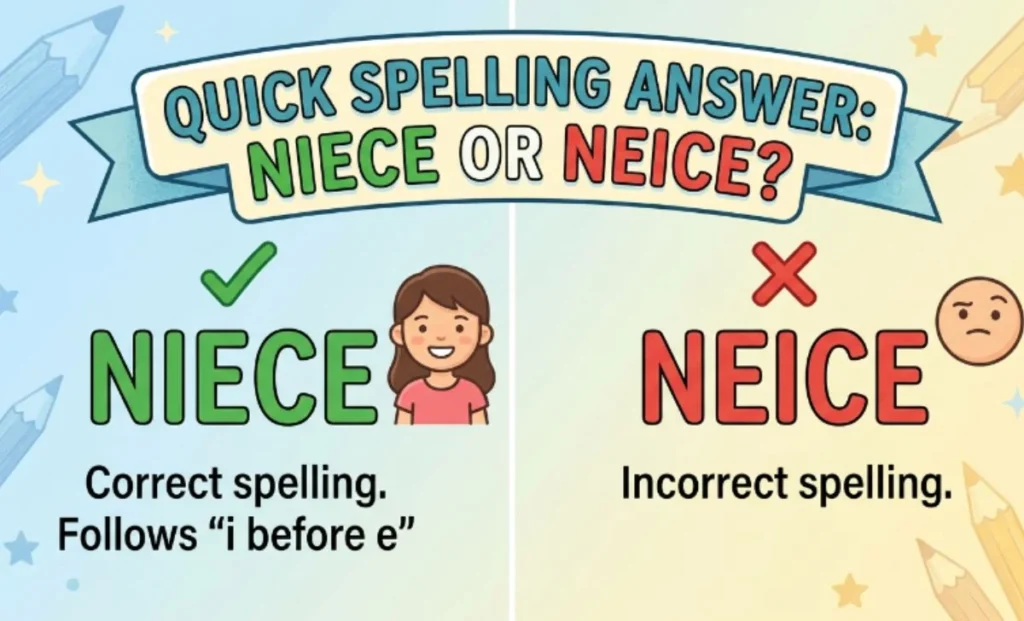
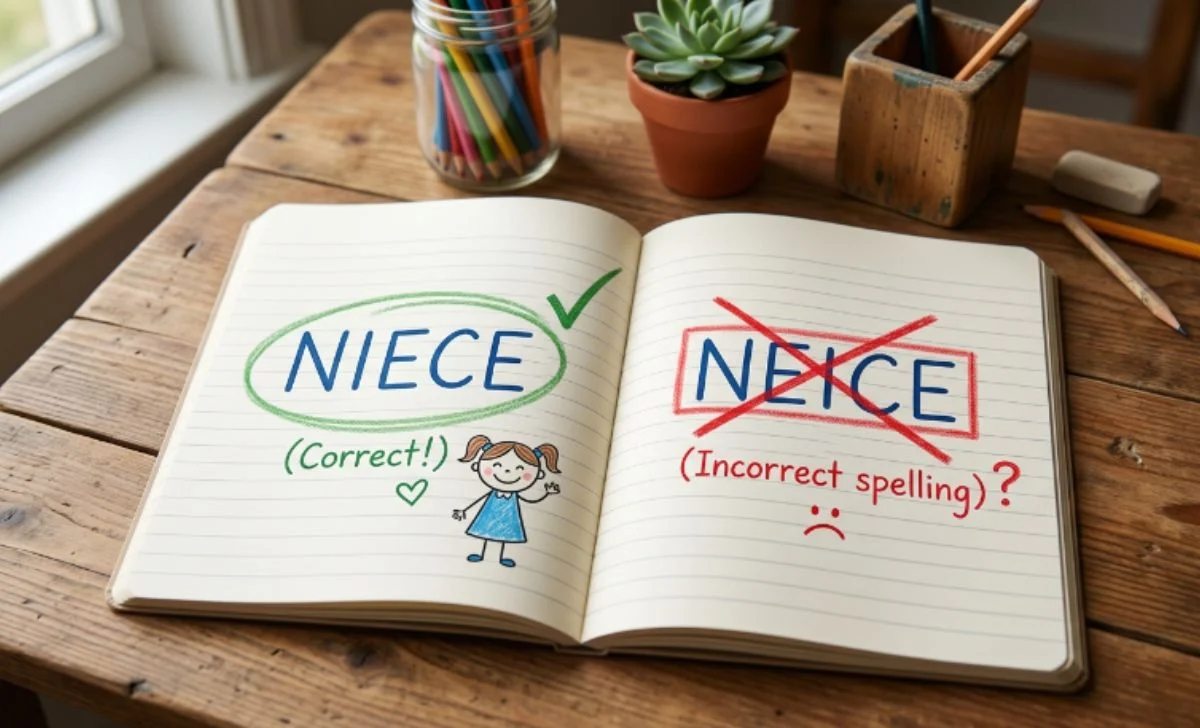
The correct spelling is “niece”.
“Neice” is a common spelling error and is not accepted in standard English.
Examples:
✔ I went shopping with my niece yesterday.
✔ My niece loves reading books.
❌ I took my neice to school.
👉 Rule: Always use niece in both British and American English.
Pronunciation of Niece or Neice
The word is pronounced as: /niːs/ (sounds like “nees”)
Key pronunciation insight:
- The spelling “neice” looks logical to beginners
- But English pronunciation does NOT reflect vowel order
- The sound stays identical regardless of spelling error
👉 This creates a classic sound-to-spelling mismatch, a major cause of confusion in English learning.
Why People Confuse Niece and Neice
This mistake is not random — it comes from cognitive and linguistic patterns.
1. Visual spelling illusion
People expect English words to follow predictable vowel order, so they assume:
👉 “neice” looks more balanced visually
2. Phonetic misunderstanding
Since both forms sound the same, learners rely on hearing instead of structure.
3. English vowel pattern confusion
English has inconsistent patterns like:
- friend (not freind)
- receive (not recieve)
This makes learners incorrectly assume similar flexibility here.
4. Typing + autocorrect influence
Fast typing and predictive text often reinforce incorrect mental spelling.
👉 This is a cognitive interference error, not just a grammar mistake.
Easy Trick to Remember Niece
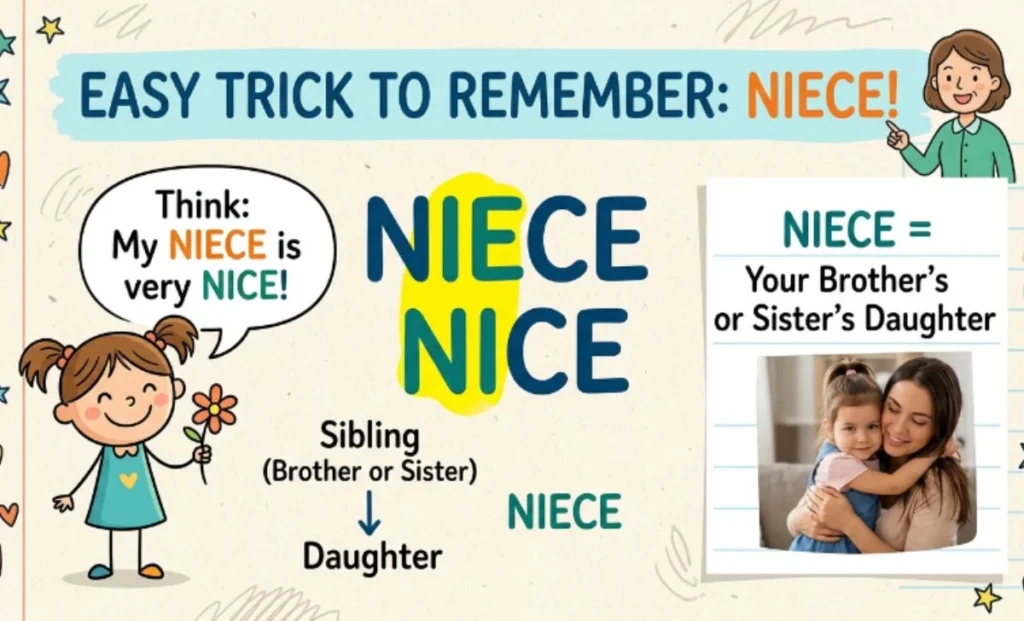
Use this simple rule:
👉 “I comes before E except after C — and NIECE follows it perfectly.”
Memory breakdown:
- “i before e” → ni + ece
- Think: niece = niecey (cute niece)
Visual trick:
Imagine your niece smiling — your brain locks the correct spelling naturally.
The Origin of Niece or Neice
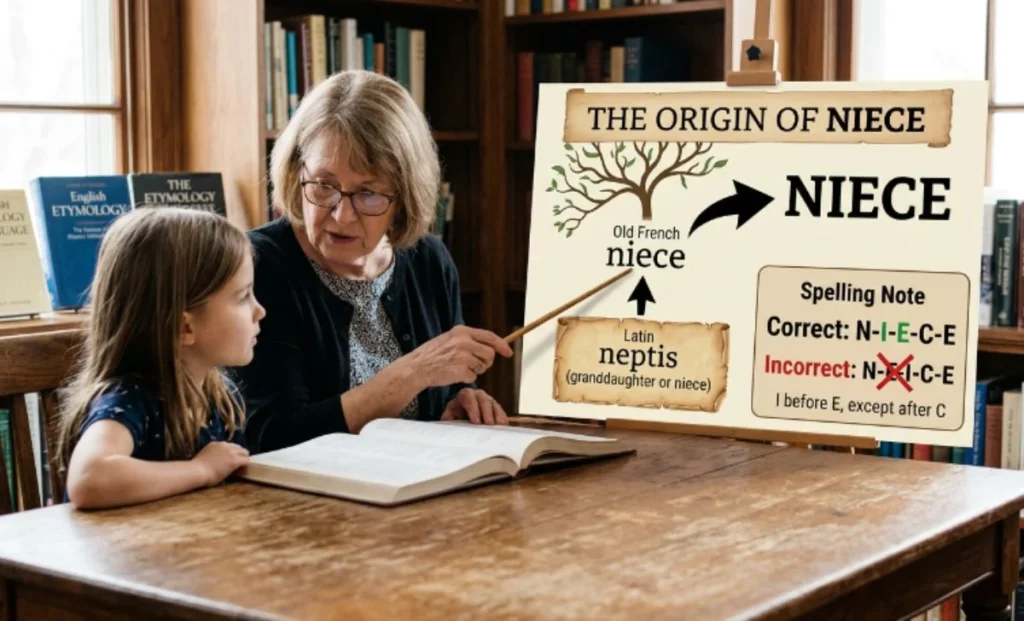
The word niece comes from Old French “niece”, which originally meant a female relative.
It traces further back to Latin “neptia”, meaning granddaughter or female descendant.
Linguistic evolution:
Latin → Old French → Middle English → Modern English “niece”
👉 Important insight:
The spelling has remained stable for centuries, which is why “neice” never became a recognized variant.
Linguistics note:
In Morphology, this word is classified as a stable inherited lexical form, meaning its structure did not undergo modern spelling reform.
British English vs American English Spelling
There is no difference between UK and US English for this word.
| Region | Correct Spelling | Incorrect Spelling |
|---|---|---|
| British English | niece | neice |
| American English | niece | neice |
| Australian English | niece | neice |
| Canadian English | niece | neice |
👉 Unlike words such as colour/color, this word is globally standardized.
Which Spelling Should You Use?
Always use “niece” in:
✔ Academic writing
✔ Emails and formal communication
✔ Exams and IELTS/TOEFL
✔ Professional documents
✔ Social media writing
Avoid “neice” completely because:
- It is not recognized in dictionaries
- It reduces writing credibility
- It signals spelling inaccuracy
👉 In formal communication, spelling errors can impact perceived professionalism.
Common Mistakes with Niece or Neice
❌ 1. Vowel swapping error
Wrong: neice
Correct: niece
❌ 2. Overthinking pronunciation
People assume spelling follows sound — it doesn’t here.
❌ 3. Autocorrect dependency
Devices may occasionally suggest incorrect forms.
❌ 4. Mixing with “nieves/nephew confusion”
Learners often confuse sibling relationship words.
Niece or Neice in Everyday Examples
Emails:
✔ I will visit my niece this weekend.
Social Media:
✔ Spending time with my niece today ❤️
News Writing:
✔ The actor attended the event with his niece.
Academic Writing:
✔ The participant included her niece in the family study sample.
👉 In all contexts, only “niece” is valid.
Niece or Neice – Google Trends & Usage Data
Search behavior shows:
- “niece” → dominant correct usage globally
- “neice” → mostly spelling correction searches
Common search intent:
- “niece or neice meaning”
- “how to spell niece”
- “is neice correct”
- “niece pronunciation”
Modern SEO insight:
Search engines like Google treat this as a spelling correction cluster, meaning:
👉 “neice” automatically maps to “niece”
This is part of modern English Linguistics behavior in NLP systems.
Comparison Table: Niece vs Neice
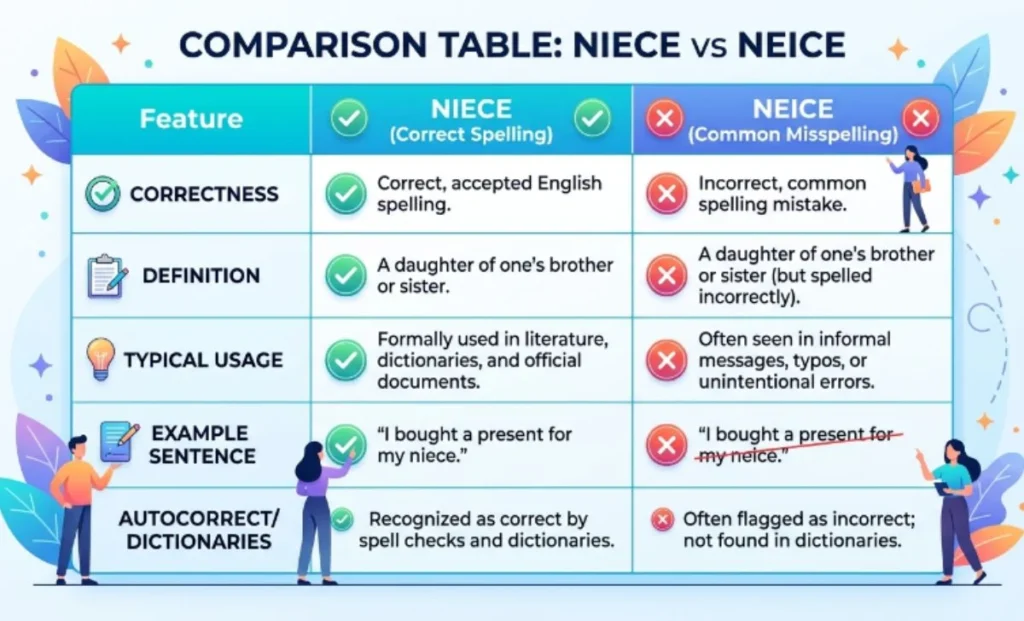
| Feature | Niece | Neice |
|---|---|---|
| Correct spelling | ✔ Yes | ❌ No |
| Dictionary accepted | ✔ Yes | ❌ No |
| Formal writing use | ✔ Yes | ❌ No |
| Pronunciation | /niːs/ | Same sound |
| Professional usage | ✔ Yes | ❌ No |
FAQs
1. Is “neice” ever correct?
No, it is always incorrect in English.
2. Why do people spell it wrong?
Because English pronunciation does not clearly show vowel order.
3. Is niece used in both UK and US English?
Yes, both use the same spelling.
4. What does niece mean?
It means the daughter of your brother or sister.
5. How do I remember the spelling?
Use “i before e except after c” and repeated practice.
6. Is niece formal or informal?
It is used in both formal and informal contexts.
Conclusion
The confusion between niece and neice is a natural result of English spelling irregularities and sound-based assumptions. However, the correct and only accepted spelling in all forms of English is niece.
The incorrect form “neice” appears due to pronunciation confusion, visual assumptions, and typing habits, but it has no linguistic or historical validity.
Understanding the origin, structure, and usage of the word helps eliminate this mistake permanently.
Whether you are writing emails, exams, or professional content, using “niece” ensures clarity, accuracy, and credibility. Once you internalize the spelling pattern, you will never need to second-guess it again.
Related Blogs:
- Loose or Lose: What’s the Difference and Why?
- Naive or Naïve: Which Spelling Should You Use and Why?