The confusion between wholistic or holistic is more common than it looks, especially in health, education, business, and wellness writing. Many people assume both words are interchangeable, while others believe “wholistic” is simply a spelling mistake.
In reality, the difference is more about usage, context, and linguistic evolution than meaning. Writers, students, and professionals often search this topic because they want to avoid errors in academic work, professional communication, and branding content.
The challenge increases because both words sound similar and relate to “whole-system thinking,” which makes spelling even more confusing. This guide explains everything in a simple way: meaning, pronunciation, confusion reasons, real usage, industry applications, and when each term is appropriate.
By the end, you will clearly understand which spelling to use and why it matters in modern English communication.
Quick Answer
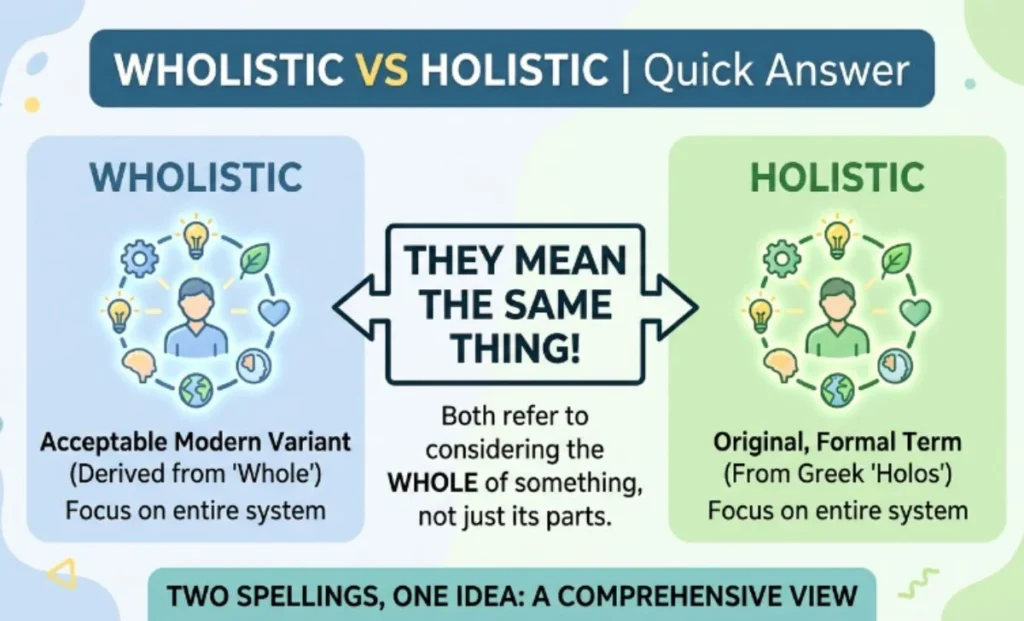
The correct and standard spelling in modern English is holistic.
It is widely used in:
- academic writing
- healthcare and medical research
- business strategy
- education systems
- scientific communication
Wholistic is a less common variant. It is mainly used in:
- wellness branding
- spiritual coaching
- lifestyle content
- alternative health communities
Examples
✔ The doctor used a holistic approach to treat the patient.
✔ The company adopted a holistic business strategy.
❌ The coach offers a wholistic treatment plan. (informal/branding use only)
Pronunciation of Wholistic vs Holistic
Both words are pronounced almost the same:
- Holistic → /hoʊˈlɪs.tɪk/
- Wholistic → /hoʊˈlɪs.tɪk/
Why confusion happens in speech:
Because English is not fully phonetic, speakers cannot hear the “w”, so learners assume spelling may also include it.
This creates a sound-to-spelling mismatch error, which is a major cause of confusion in ESL writing.
Why People Confuse Wholistic and Holistic
This confusion is not random — it comes from how the brain processes language.
1. Visual logic error (brain assumption)
People associate:
- “whole” = complete system
So they assume:
👉 “wholistic” should match “whole”
2. Sound vs spelling conflict
English pronunciation does not clearly show spelling differences, so learners rely on mental logic instead of rules.
3. Pattern recognition mistake
Words like:
- whole
- wholesome
- wholly
push users to incorrectly create “wholistic.”
4. AI + autocomplete influence
Search engines and autocorrect sometimes suggest incorrect variants, reinforcing confusion.
Easy Trick to Remember
Use this simple memory rule:
👉 Holistic comes from “holos” (Greek for whole), not English “whole.”
Shortcut:
- Holos → Holistic ✔
- Whole → Wholistic ❌ (visual mistake only)
The Origin of Wholistic or Holistic
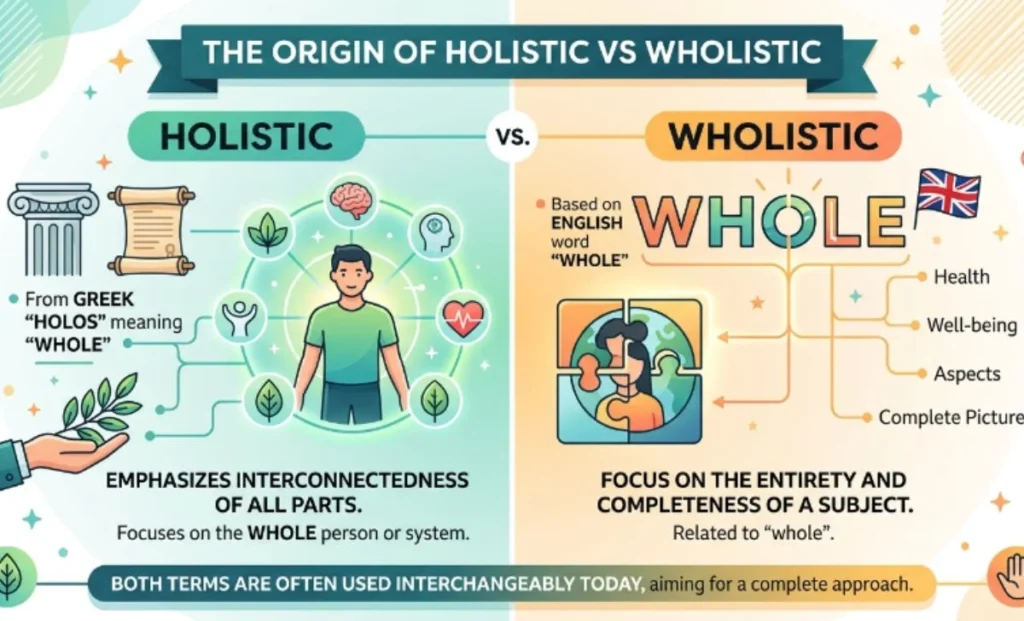
The word holistic comes from the Greek word “holos”, meaning whole or complete.
This led to the concept of:
- holism → systems thinking
- holistic → whole-system approach
Over time, the spelling became standardized in academic and scientific English as holistic.
Why “wholistic” appeared later:
It was created informally to visually connect the word with “whole,” but it never became standard in formal language systems.
Holistic or Wholistic in Real-World Usage (Industry Matrix)
Healthcare
- Holistic medicine considers body, mind, and lifestyle.
- Used in hospitals, research, and clinical practice.
Business
- Holistic strategy connects marketing, operations, and customer experience.
Education
- Holistic learning includes emotional, social, and academic growth.
Wellness & Branding
- Wholistic is used in:
- yoga studios
- coaching brands
- spiritual retreats
👉 Example:
“The brand promotes a wholistic healing journey.” (branding tone, not academic)
Which Spelling Should You Use?
| Situation | Recommended Word | Reason |
|---|---|---|
| Academic writing | Holistic | Standard English |
| Medical field | Holistic | Scientific accuracy |
| Business reports | Holistic | Professional tone |
| Wellness branding | Wholistic | Emotional/branding style |
| SEO content | Holistic | Higher search authority |
👉 If unsure, always choose holistic.
Common Mistakes with Wholistic vs Holistic
❌ Using wholistic in academic essays
❌ Assuming both are equal in formal English
❌ Writing “wholistic medicine” in research papers
❌ Treating it as spelling variation like color/colour
Correct usage:
✔ holistic approach
✔ holistic health
✔ holistic strategy
Wholistic vs Holistic in Everyday Examples
Healthcare
“The hospital follows a holistic care model.”
Business
“We need a holistic view of customer experience.”
Social Media
“Yoga supports a holistic lifestyle.”
Branding
“Our wholistic coaching program focuses on energy and mindset.”
Google Trends & Usage Behavior
Search behavior shows:
- “holistic” → dominant global usage
- “wholistic” → niche usage in wellness branding and spelling confusion queries
User intent behind searches:
- spelling clarification
- academic correctness
- wellness branding decisions
- SEO content optimization
Modern SEO insight:
Google interprets “wholistic vs holistic” as a single semantic entity, not two equal variants. This means:
👉 Holistic is treated as the authoritative term in NLP ranking systems.
Comparison Table
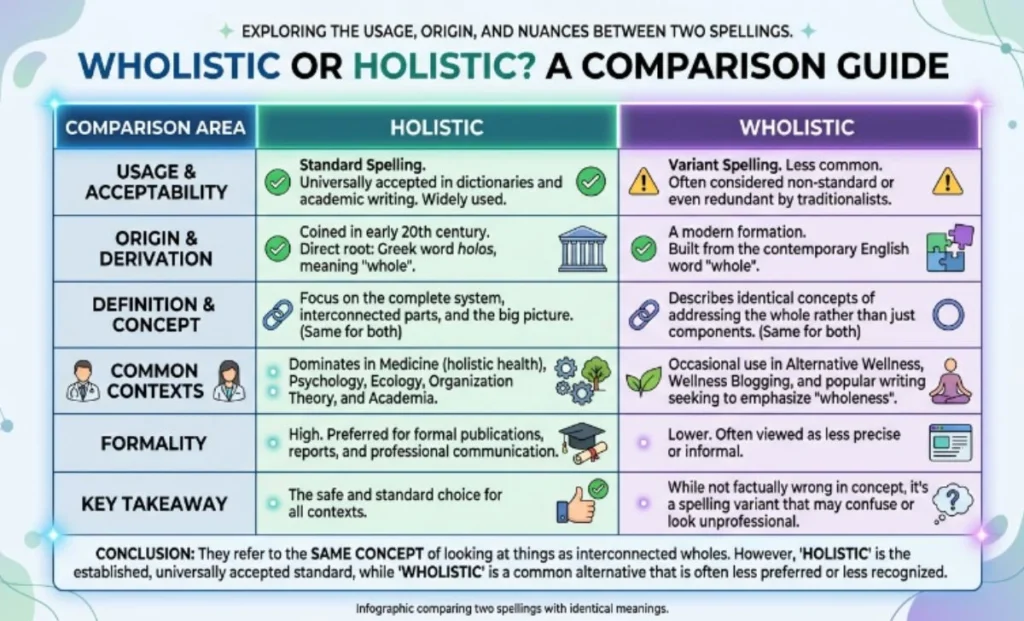
| Feature | Holistic | Wholistic |
|---|---|---|
| Standard spelling | ✔ Yes | ❌ No |
| Academic use | ✔ Yes | ❌ Rare |
| Branding use | ✔ Yes | ✔ Yes |
| Dictionary support | ✔ Yes | Limited |
| Search dominance | High | Low |
FAQs
1. Is wholistic correct?
It is a variant spelling but not standard in formal English.
2. Is holistic and wholistic the same?
Yes in meaning, but not in usage or acceptance.
3. Why is holistic spelled without “w”?
It comes from Greek “holos,” not the English word “whole.”
4. Can I use wholistic in academic writing?
No, it is not recommended.
5. What is holistic used for?
It is used in healthcare, education, business, and systems thinking.
6. Is wholistic a real word?
It exists, but mainly in informal or branding contexts.
Final Verdict
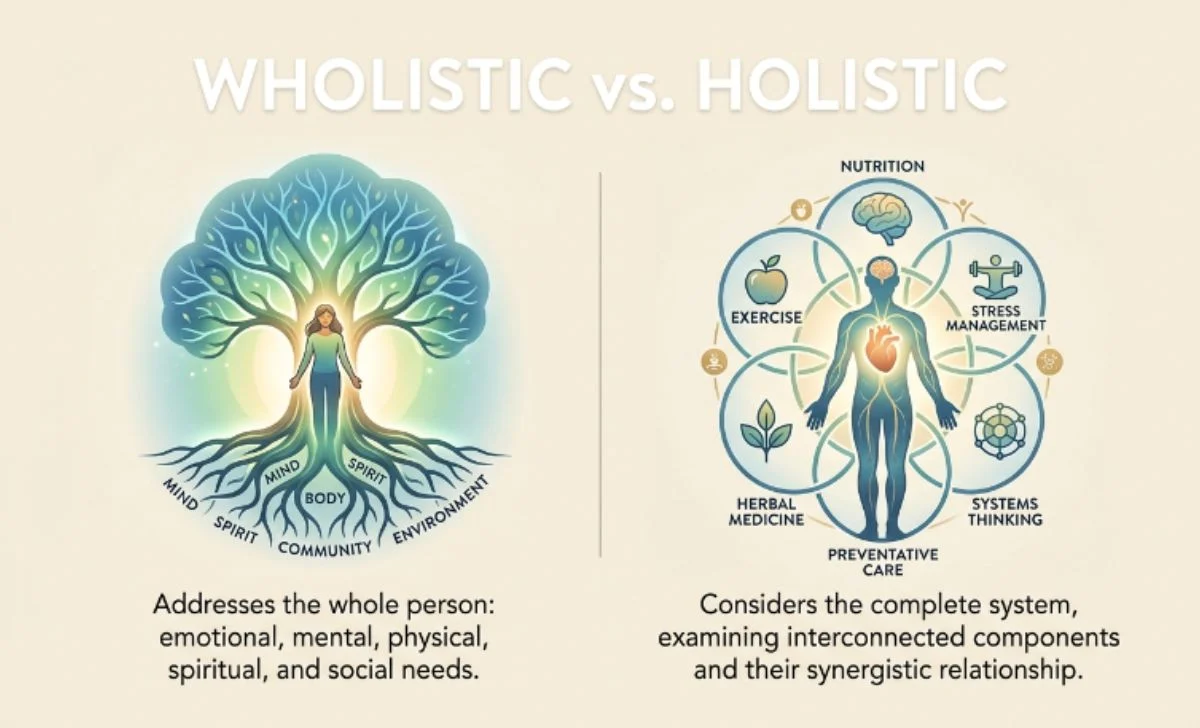
When comparing wholistic vs holistic, the difference is not about meaning but about language authority and usage context. Holistic is the standard, widely accepted form used in academic, medical, and professional communication.
Wholistic is a stylistic variant used mainly in wellness and branding spaces to emphasize emotional “whole-person” identity.
If your goal is clarity, professionalism, or SEO authority, always choose holistic. It is recognized globally and preferred by educators, editors, and search engines. However, if you are building a brand identity in wellness or spirituality, wholistic can be used intentionally for tone.
Understanding this distinction helps you write more confidently, avoid credibility issues, and improve communication across different audiences.
Related Blogs:
- Laying or Lying: Which Word Should You Use in 2026?
- Fortreen or Fourteen – Which One is Correct and Why?