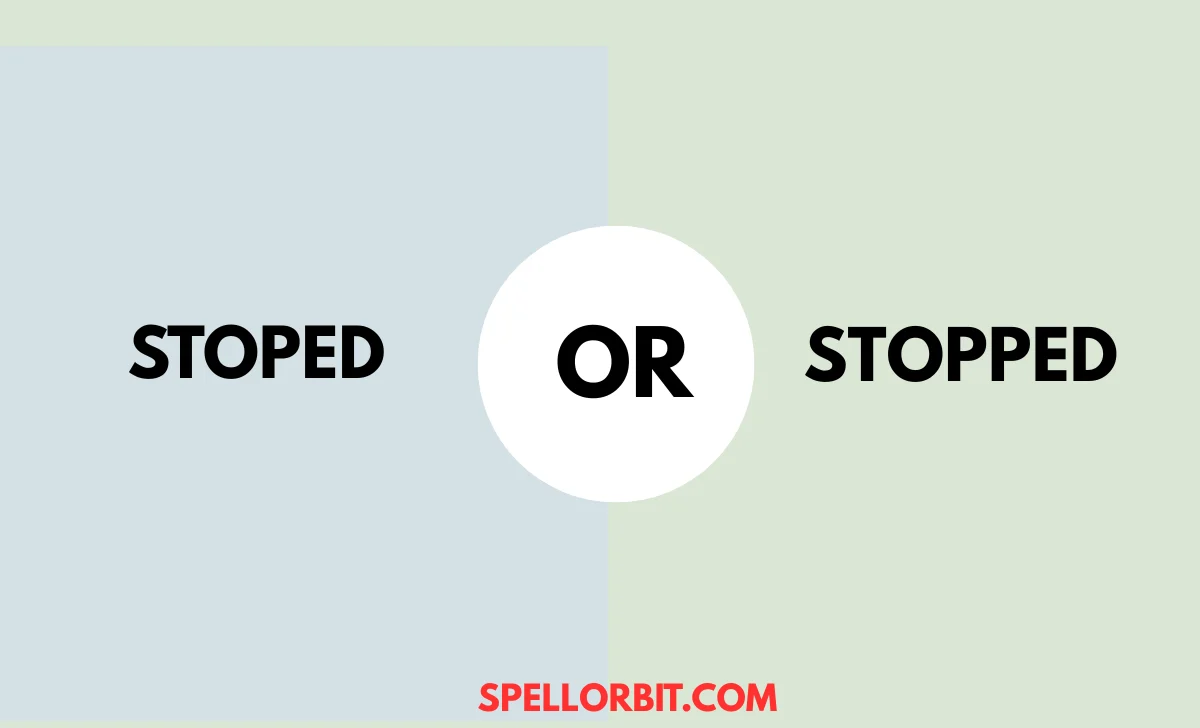
Stopped is the correct spelling, while stoped is a common spelling mistake.
The confusion happens because the verb stop ends in a consonant after a short vowel, so the final consonant is doubled before adding -ed or -ing.
This rule can be easy to miss, especially when writing quickly or relying on how the word sounds.
In this guide, you will learn why stopped has two p letters, where the spelling comes from, how British and American English treat it, and how to use it correctly.
You will also see common mistakes, everyday examples, usage patterns, and simple answers to frequent questions.
Quick Answer
Stopped is the correct spelling.
Stoped is incorrect in standard English.
The word stopped is the past tense and past participle of the verb stop.
Examples:
- The car stopped at the red light.
- She stopped talking.
- The rain stopped this morning.
- He has stopped eating junk food.
- The bus stopped outside the school.
Why Is It “Stopped”?
The base verb is stop. When a short, one-syllable verb ends in a consonant after a short vowel, the final consonant is usually doubled before adding -ed.
stop + ed = stopped
The same rule applies to the -ing form:
stop + ing = stopping
Therefore:
| Incorrect | Correct |
|---|---|
| stoped | stopped |
| stoping | stopping |
Remember: stop has one p, but stopped and stopping have two p’s.
The Origin of Stoped or Stopped
The word stop has a long history in English. It comes through Middle English forms such as stoppen, which were influenced by Old English and related Germanic words. Over time, stop became the standard modern English form.
The spelling stopped developed from the normal English method of adding a suffix to certain short verbs. When stop receives -ed, the final p is doubled.
This gives us:
stop → stopped
The doubled consonant helps show that the vowel before it remains short. Similar spelling patterns appear in words such as:
- plan → planned
- rob → robbed
- drop → dropped
- shop → shopped
- clap → clapped
The spelling stoped may look logical because writers sometimes expect to add -ed directly to the base word. However, standard English spelling rules require the final p to be doubled.
British English vs American English Spelling
There is no difference between British and American English for this word.
Both varieties use:
stopped
Examples:
- British English: The train stopped at the station.
- American English: The train stopped at the station.
The same rule applies to stopping.
| Form | British English | American English |
|---|---|---|
| Base verb | stop | stop |
| Past tense | stopped | stopped |
| Past participle | stopped | stopped |
| Present participle | stopping | stopping |
| Incorrect form | stoped | stoped |
Some English words have different British and American spellings, such as travelled/traveled and cancelled/canceled. However, stopped is not one of them.
Which Spelling Should You Use?
Use stopped in all forms of standard English.
If You Write American English
Use stopped in school work, business writing, emails, websites, and professional documents.
Example:
The manager stopped the meeting at noon.
If You Write British English
Use stopped in the same way.
Example:
The manager stopped the meeting at noon.
For Global English
Stopped is the safest and correct form for international communication. It is understood across English-speaking countries and follows standard spelling rules.
You should avoid stoped in professional and academic writing because it is considered a spelling error.
Common Mistakes with Stoped or Stopped
The most common mistake is writing stoped instead of stopped.
Mistake 1: Stoped
Incorrect: The car stoped suddenly.
Correct: The car stopped suddenly.
Mistake 2: Stoping
Incorrect: She is stoping the machine.
Correct: She is stopping the machine.
Mistake 3: Forgetting the Double P
Incorrect: The music stoped at midnight.
Correct: The music stopped at midnight.
Mistake 4: Confusing Past and Present Forms
Incorrect: Yesterday, the bus stop at the corner.
Correct: Yesterday, the bus stopped at the corner.
Easy Rule
When stop takes -ed or -ing, double the final p:
stop → stopped → stopping
This is a useful spelling pattern to remember.
Stoped or Stopped in Everyday Examples
The word stopped is very common in everyday English. You can use it in casual speech, emails, news reports, social media posts, and formal writing.
In Emails
The delivery stopped because of bad weather.
I stopped working on the report until I received the missing data.
In News Writing
The police stopped the vehicle near the city center.
Heavy rain stopped traffic across the area.
On Social Media
I finally stopped worrying about it.
The rain stopped, so we went outside.
In Formal Writing
The company stopped production after identifying a safety issue.
The research team stopped the experiment after reviewing the results.
In Everyday Conversation
I stopped at the store on my way home.
She stopped laughing when she heard the news.
Stoped or Stopped – Comparison Table
| Word | Correct? | Meaning | Example |
|---|---|---|---|
| stop | Yes | To cease or halt | Please stop talking. |
| stopped | Yes | Past tense of stop | The car stopped. |
| stopping | Yes | -ing form of stop | The bus is stopping. |
| stoped | No | Incorrect spelling | Avoid this form. |
| stoping | No | Incorrect spelling | Use stopping instead. |
The key difference is the doubled p in the correct forms.
Stoped or Stopped – Google Trends & Usage Data
Search interest for stopped is naturally much higher than stoped because stopped is the standard English spelling.
People may search for “stoped or stopped” when they are unsure whether the final consonant should be doubled. This type of spelling query often appears in educational searches, grammar checks, school work, and online writing tools.
The correct form, stopped, is used across major English-speaking regions, including:
- United States
- United Kingdom
- Canada
- Australia
- New Zealand
- Ireland
Unlike words that have British and American spelling differences, stopped remains the same in both major forms of English.
The spelling pattern is also consistent across contexts. Whether you are writing a text message, an academic paper, a news article, or a business email, stopped is the correct choice.
Why Do We Double the P in Stopped?
The double p follows a common English spelling rule.
When a short verb ends in:
short vowel + consonant
the final consonant is often doubled before a suffix beginning with a vowel.
For stop:
- o = short vowel
- p = final consonant
So:
stop + ed → stopped
And:
stop + ing → stopping
Other examples include:
- hop → hopped
- chat → chatted
- grab → grabbed
- slip → slipped
- trim → trimmed
This rule helps preserve the pronunciation of the original short vowel.
How to Remember Stopped
Use this simple memory trick:
STOP has one P. STOPPED has two Ps.
Think of the word STOP as a sign. When something has already stopped, the P gets a partner.
You can also remember the pattern:
hop → hopped
drop → dropped
stop → stopped
If you know these examples, stopped becomes easier to spell correctly.
FAQS
Is “stoped” a correct word?
No. Stoped is not the standard spelling of the past tense of stop. The correct spelling is stopped.
Is “stopped” spelled with two Ps?
Yes. Stopped contains two p letters.
stop → stopped
Why is the P doubled in stopped?
The p is doubled because stop is a short verb ending in a short vowel followed by a single consonant. The spelling rule requires the final consonant to be doubled before -ed.
Is “stoping” correct?
No. The correct spelling is stopping, with two p letters.
stop → stopping
Is stopped the same in British and American English?
Yes. Both British and American English use stopped.
What is the past tense of stop?
The past tense is stopped.
Example:
The train stopped at the station.
What is the difference between stop and stopped?
Stop is the base form, while stopped is the past tense and past participle.
Example:
- Please stop talking.
- She stopped talking.
Conclusion
Stopped is the correct spelling, and stoped is incorrect because the final p must be doubled before adding -ed.
The same doubling rule gives us stopping, so remembering the pattern stop → stopped → stopping can prevent both common mistakes.
This spelling is the same in British and American English, making stopped the right choice for every standard English context.
When writing an email, report, school assignment, or social media post, always use stopped when describing something that has already ceased or ended.
For another useful spelling guide, read our related post on “planned or planed” to learn the same consonant-doubling rule.
Related Posts:
- Openned or Opened:Which One Should You Use?
- Where as or Whereas: Which Spelling Is Correct?
- Rod Iron or Wrought Iron: Which Spelling Is Correct?