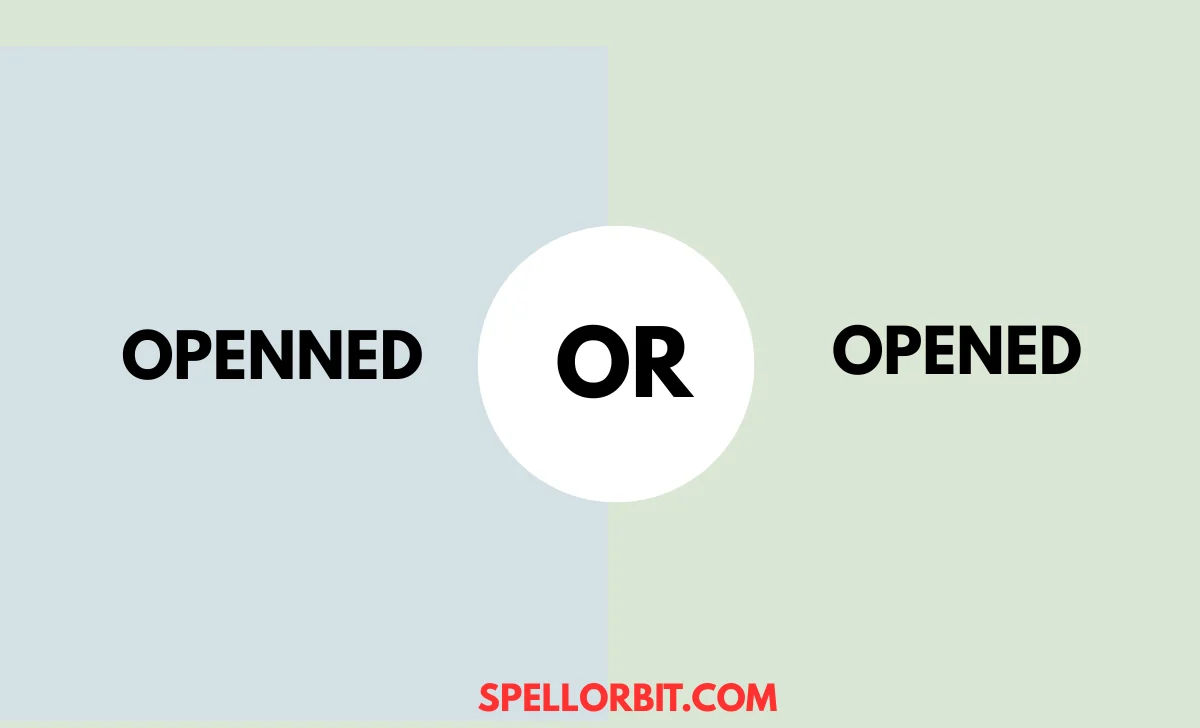
Opened is the correct spelling, while openned is incorrect.
The word opened is the past tense and past participle of the verb open, and it is formed by adding -ed without doubling the final n.
People often write openned because English has many verbs that double their final consonant before adding an ending, such as stop → stopped and plan → planned. However, open does not follow that pattern.
This guide explains why opened is correct, where the word comes from, how British and American English treat it, common mistakes to avoid, and how to use opened correctly in everyday, professional, and formal writing.
Quick Answer
Opened is the correct spelling.
Openned is a misspelling and should not be used in standard English.
The word opened is the past tense and past participle of open.
Examples:
- She opened the door.
- He opened the box.
- The shop opened at 9 a.m.
- I opened the email.
- They have opened a new office.
Incorrect:
- She openned the door. ❌
- He openned the box. ❌
- The shop openned at 9 a.m. ❌
The simple rule is:
open + ed = opened
There is only one n.
The Origin of Openned or Opened
The word opened comes from the verb open. The English verb can be traced back to Old English openian, meaning “to open,” “open up,” “disclose,” or “reveal.” It is related to older Germanic words with similar meanings.
Over time, open became a common English verb with both physical and figurative meanings.
For example:
- Open a door.
- Open a window.
- Open a book.
- Open a meeting.
- Open a discussion.
- Open an account.
The past tense is formed in the normal way:
Open → Opened
The confusion comes from English consonant-doubling rules. Some verbs double their final consonant before adding an ending:
- Stop → stopped
- Plan → planned
- Shop → shopped
- Beg → begged
Because learners see these patterns, they may assume:
Open → openned
But that form is wrong.
The word open has two syllables: O-pen. The stress is on the first syllable. Therefore, the final n is not doubled when -ed is added.
So remember:
Open → opened ✅
Open → openned ❌
British English vs American English Spelling
There is no British-American spelling difference between opened and openned.
Both British English and American English use:
opened
The same spelling is also used in Canadian, Australian, and other major forms of English.
| Version | British English | American English | Correct? |
|---|---|---|---|
| opened | opened | opened | ✅ Yes |
| openned | openned | openned | ❌ No |
| open | open | open | ✅ Yes |
| opening | opening | opening | ✅ Yes |
For example:
British English:
“The museum opened at ten.”
American English:
“The museum opened at ten.”
The spelling stays the same.
This is different from words such as colour/color, centre/center, and organise/organize, where British and American English may use different spellings.
With opened, there is only one standard spelling.
Which Spelling Should You Use?
Use opened no matter where your audience is located.
For American English
Use opened in:
- School assignments
- Emails
- Reports
- Websites
- Business documents
- Social media posts
Example:
“The company opened a new store in Texas.”
For British English
Use opened in:
- Essays
- Formal letters
- News writing
- Business communication
- Academic writing
Example:
“The library opened its new reading room yesterday.”
For Global English
If you write for an international audience, opened is also the correct choice.
There is no need to change the spelling based on the country.
Best choice: opened
Common Mistakes with Openned or Opened
1. Adding an extra n
Incorrect:
“I openned the door.”
Correct:
“I opened the door.”
2. Copying the pattern from “planned”
Some writers know that plan becomes planned and apply the same rule to open.
But these words follow different spelling patterns.
- Plan → planned
- Stop → stopped
- Open → opened
3. Using “openned” in formal writing
The spelling openned is not standard English. It should not appear in:
- Resumes
- Cover letters
- School essays
- Academic papers
- Business emails
- Reports
- Professional websites
4. Confusing “open” and “opened”
These words can have different grammatical roles.
Open can describe a current state:
“The door is open.”
Opened describes a completed action:
“She opened the door.”
Cambridge Dictionary also explains that opened is the past form of the verb open.
5. Writing “opend”
Another common typo is:
“I opend the file.”
The correct spelling is:
“I opened the file.”
Openned or Opened – Comparison Table
| Word | Meaning | Correct? | Example |
|---|---|---|---|
| opened | Past tense of open | ✅ Correct | She opened the door. |
| openned | Misspelling of opened | ❌ Incorrect | She openned the door. |
| open | Base form of the verb | ✅ Correct | Please open the door. |
| opening | Present participle/gerund | ✅ Correct | He is opening the box. |
| opens | Third-person singular present | ✅ Correct | The store opens at 9. |
The key difference is simple: opened has one n, while openned incorrectly has two.
Openned or Opened in Everyday Examples
In Emails
Correct:
“I opened the document you sent and reviewed the first page.”
Incorrect:
“I openned the document you sent.”
For professional emails, always use opened.
In News Writing
Correct:
“The new hospital opened its doors to patients on Monday.”
News writing often uses opened when reporting that a building, business, service, or event began operating.
On Social Media
Correct:
“I finally opened my new package!”
Another example:
“The store opened today!”
The correct spelling remains opened, even in casual posts.
In Formal Writing
Correct:
“The researcher opened the discussion by explaining the main findings.”
Or:
“The company opened a new branch in the city.”
In Everyday Conversation
You might say:
- “I opened the window.”
- “She opened the letter.”
- “He opened his laptop.”
- “We opened the package.”
- “They opened the meeting.”
In every case, use opened.
Opened – Grammar and Usage
Opened has two main grammatical uses.
Past Tense
Use opened to describe an action that happened in the past.
Example:
“She opened the window this morning.”
The action happened in the past.
Past Participle
Use opened with helping verbs such as has, have, and had.
Examples:
- She has opened the letter.
- They have opened a new branch.
- He had opened the package before lunch.
It can also appear in passive constructions:
“The new store was opened last week.”
Dictionary sources list opened as both the simple past and past participle of open.
Openned or Opened – Google Trends & Usage Data
Search interest around “openned or opened” comes mainly from people checking spelling and grammar. The search is usually driven by students, English learners, bloggers, and writers who are unsure whether the final n should be doubled.
The important usage point is clear: opened is the established standard form, while openned is treated as a spelling error.
The correct form is used across major English-speaking countries, including:
- United States
- United Kingdom
- Canada
- Australia
- New Zealand
- India
- Pakistan
There is no country-specific version of opened.
Searches for this spelling pair are therefore more about learning and correcting an error than about choosing between two accepted regional spellings.
For content creators and SEO writers, the best approach is to use opened naturally and explain openned only when discussing the spelling mistake.
Easy Trick to Remember Opened
Use this simple formula:
OPEN + ED = OPENED
Do not add another n.
You can also compare it with the base word:
open
opened
The word keeps its original spelling and simply adds -ed.
Think:
One n in open → one n in opened.
This quick memory rule can help you avoid the mistake in emails, essays, and online writing.
FAQS
1. Is openned or opened correct?
Opened is correct. Openned is an incorrect spelling.
2. Why is opened spelled with one n?
The verb open does not double its final n when -ed is added. The correct form is open + ed = opened.
3. Is openned a word?
No. Openned is not a standard English spelling. It is a common misspelling of opened.
4. Is opened correct in British English?
Yes. Opened is the standard spelling in British English.
5. Is opened correct in American English?
Yes. American English also uses opened.
6. What is the past tense of open?
The past tense is opened.
Example:
“She opened the door.”
7. What is the past participle of open?
The past participle is also opened.
Example:
“She has opened the door.”
Conclusion
The correct spelling is opened, not openned, because the verb open takes -ed without doubling its final n.
The same spelling is used in British English, American English, and other major forms of English, so you do not need to change it for your audience.
The practical takeaway is simple: remember open + ed = opened, and avoid adding a second n.
If you are learning other commonly confused spellings, consider reading our related guide on [another common spelling mistake] to build stronger everyday English skills and write with greater confidence.
Related Posts:
- Congradulations or Congratulations: Examples and Rules?
- Rod Iron or Wrought Iron: Which Spelling Is Correct?
- Where as or Whereas: Which Spelling Is Correct?