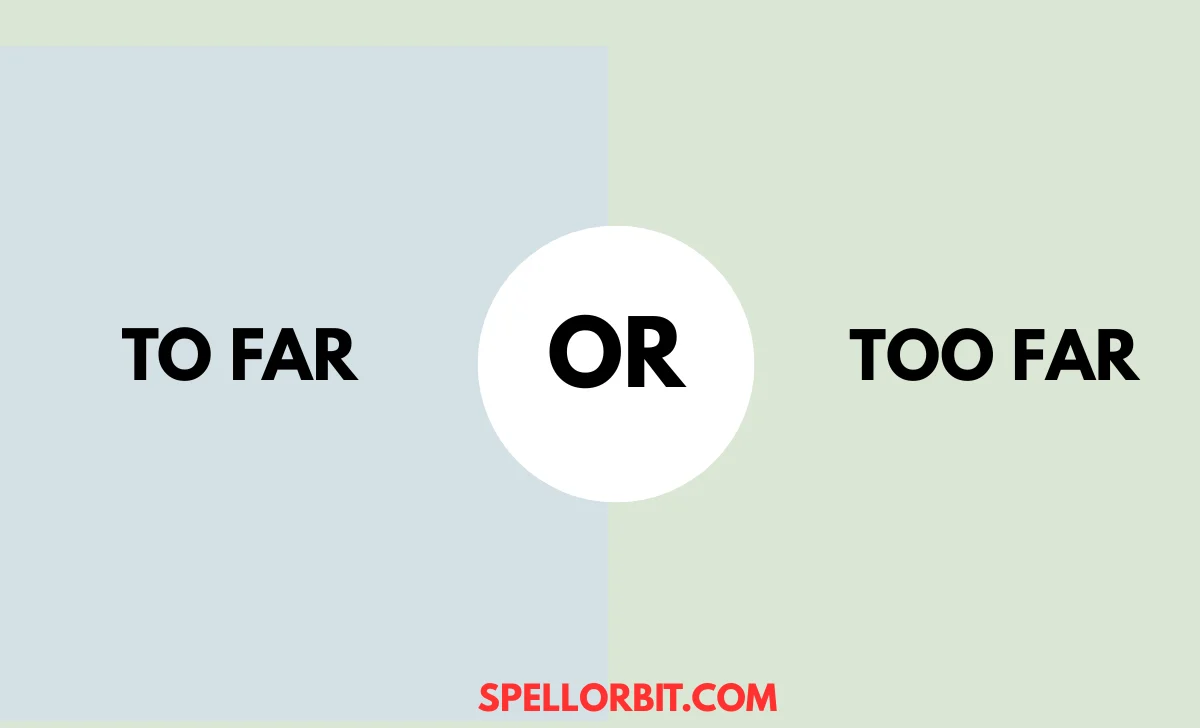
Too far is the correct phrase when you mean something is excessive, beyond an acceptable limit, or a great distance.
To far is almost always a grammatical mistake because to is a preposition and far is an adverb or adjective that usually needs other words to complete the sentence.
This confusion happens because to and too sound exactly the same in English, making them easy to mix up in writing.
In this guide, you’ll learn the correct meaning, grammar rules, examples, common mistakes, spelling differences, and simple tricks to remember when to use too far instead of to far.
Quick Answer
Too far is correct.
To far is incorrect in standard English unless to belongs to the verb before it and far begins a separate phrase, which is very uncommon.
Correct examples:
- The school is too far from my house.
- Your joke went too far.
- We walked too far and became tired.
Incorrect examples:
- ❌ The school is to far away.
- ❌ You pushed the joke to far.
Easy rule:
- Too = more than enough or excessively.
- To = shows direction, purpose, or follows certain verbs.
The Origin of To Far or Too Far
The confusion comes from the words to and too, not from far.
The word to comes from Old English tō, meaning “toward” or “in the direction of.” It has always been used as a preposition or part of the infinitive form of a verb.
The word too also comes from Old English, from tō, but its meaning changed over time to mean also or more than enough. English later kept different spellings to separate the two meanings.
The word far comes from Old English feorr, meaning “at a great distance.”
Today, too far means either:
- More than the acceptable limit.
- At a distance that is greater than desired.
The spelling difference exists because to and too have different grammatical jobs even though they sound the same.
British English vs American English Spelling
There is no spelling difference between British English and American English.
Both use too far in exactly the same way.
| English Variety | Correct Form | Example |
|---|---|---|
| American English | Too far | That office is too far away. |
| British English | Too far | The station is too far to walk. |
| Canadian English | Too far | We drove too far. |
| Australian English | Too far | Your comment went too far. |
Both varieties treat to far as an error.
Which Spelling Should You Use?
If you write for an American audience, use too far whenever you mean “excessively” or “beyond the limit.”
If you write for a British or Commonwealth audience, the rule is exactly the same.
For international readers, always choose too far because it is the standard English form understood everywhere.
Unless to belongs to another grammatical structure, never write to far.
Common Mistakes with To Far or Too Far
People usually confuse these words because they are homophones.
Mistake 1
❌ The movie theater is to far.
✅ The movie theater is too far.
Mistake 2
❌ You have taken the joke to far.
✅ You have taken the joke too far.
Mistake 3
❌ We walked to far yesterday.
✅ We walked too far yesterday.
Remember This Trick
Replace the word with very.
If very far makes sense, you probably need too far.
Example:
“The shop is too far.”
“The shop is very far.”
Both work, so too far is correct.
To Far or Too Far in Everyday Examples
Emails
- The meeting location is too far from our office.
- Your suggested deadline is too far in the future.
News
- Rescue teams could not travel because the village was too far from the main road.
- Fuel prices have risen too far, according to experts.
Social Media
- That challenge went too far.
- We drove too far and got lost.
Formal Writing
- The evidence does not go too far in proving the claim.
- The proposal extends too far beyond the project’s scope.
To Far or Too Far – Google Trends & Usage Data
Search data consistently shows that too far is overwhelmingly more popular because it is the correct phrase.
The incorrect spelling to far still receives many searches because people often type what they hear instead of following grammar rules.
Countries where too far is commonly searched include:
- United States
- United Kingdom
- Canada
- Australia
- India
Most searches for to far come from users checking whether the spelling is correct.
Comparison Table
| Phrase | Correct? | Meaning | Example |
|---|---|---|---|
| Too far | ✅ Yes | Excessive distance or beyond the limit | The hotel is too far away. |
| To far | ❌ No | Usually a grammar mistake | Incorrect in normal writing. |
| Too far away | ✅ Yes | Very distant | The airport is too far away. |
| Go too far | ✅ Yes | Exceed acceptable limits | His criticism went too far. |
FAQS
Is “to far” ever correct?
Almost never. In standard English, too far is the correct phrase.
Why do people write “to far”?
Because to and too sound the same, many people choose the wrong spelling.
Does “too far” mean distance only?
No. It can describe physical distance or actions that exceed acceptable limits.
Is “too far” correct in British English?
Yes. British English and American English both use too far.
How can I remember the correct spelling?
Think of too as meaning more than enough. If something is beyond the limit, use too far.
Can “too far” describe behaviour?
Yes.
Example:
- His comments went too far.
Is “too far away” correct?
Yes. It is a common and completely correct English phrase.
Conclusion
Too far is the correct phrase whenever you mean a distance is greater than desired or a person, action, or idea has exceeded an acceptable limit.
The phrase to far is almost always a spelling mistake caused by confusing the homophones to and too.
A simple way to remember the rule is that too means more than enough, while to usually shows direction or introduces an infinitive verb.
Before publishing your writing, quickly check for this common error. You may also enjoy reading our related guide on Too or To for more easy grammar tips.
Related Posts:
- Parent’s or Parents’:What Is the Difference?
- Thankyou or Thank You: Which Is Correct?
- Totalling or Totaling: Which Spelling Is Correct?