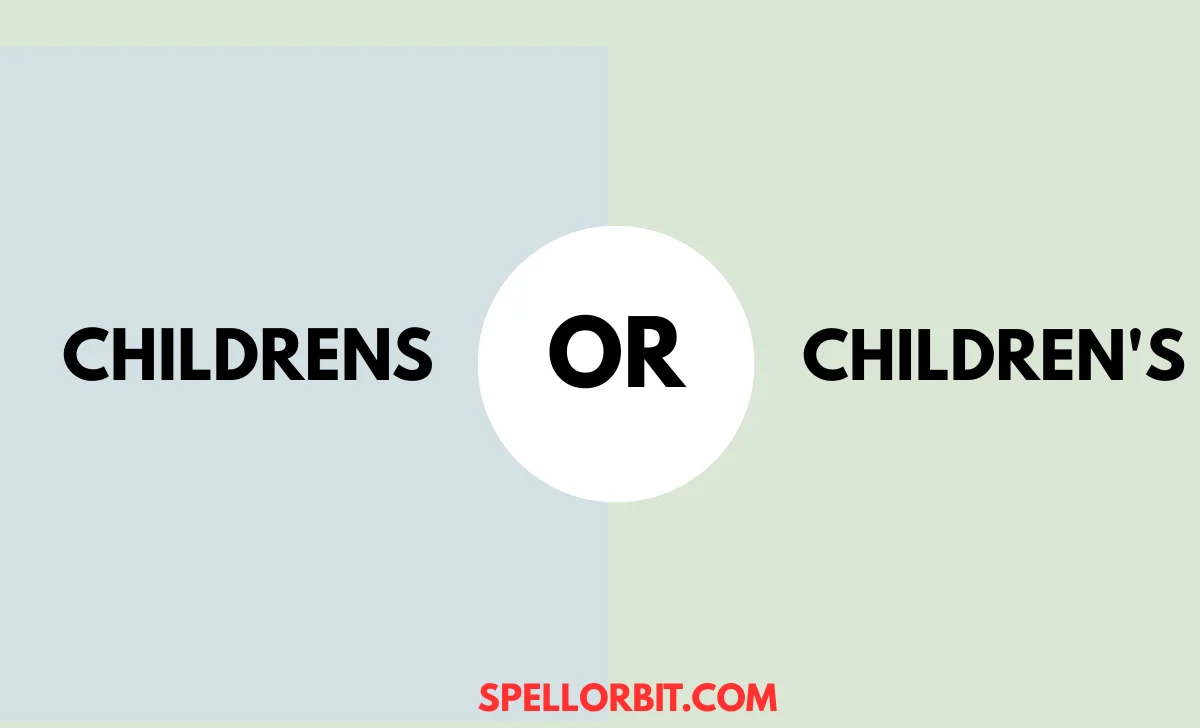
Children’s is the correct possessive form of children, while childrens’ is incorrect because children is already an irregular plural noun.
Many writers become confused because most plural nouns form the possessive by adding only an apostrophe, but children does not follow that rule.
This difference leads to frequent spelling mistakes in schoolwork, business writing, emails, and online content. In this guide, you’ll learn the correct grammar rule, the history behind the word,
British and American English usage, common mistakes, practical examples, comparison tables, FAQs, and tips to remember the correct spelling every time.
Quick Answer
The correct spelling is children’s.
Children’s means belonging to or relating to children.
❌ Childrens’ is incorrect because children is already plural.
Examples
✅ Children’s books are popular worldwide.
✅ The children’s playground is open today.
✅ We visited the children’s museum yesterday.
❌ Childrens’ toys are on sale.
❌ Childrens’ hospital provides excellent care.
Quick Rule
- Singular noun → add ‘s
- Regular plural ending in -s → add ‘
- Irregular plural not ending in -s → add ‘s
Since children is an irregular plural, the correct possessive is children’s.
The Origin of Childrens’ or Children’s
The word child comes from Old English cild, meaning a young person.
Its plural became children, which developed during Middle English. Unlike regular nouns that simply add -s, children is an irregular plural, similar to:
- man → men
- woman → women
- person → people
- child → children
Because children does not end in s, English grammar requires adding ‘s to show possession.
That is why children’s became the standard possessive form.
The form childrens’ developed from misunderstanding the apostrophe rule. People sometimes think every plural noun only needs an apostrophe after the final s, but that rule applies only to regular plurals ending in s, not irregular plurals.
British English vs American English Spelling
There is no spelling difference between British English and American English.
Both use children’s.
The incorrect spelling childrens’ is not accepted in either variety of English.
| British English | American English | Correct? |
|---|---|---|
| children’s books | children’s books | ✅ |
| children’s hospital | children’s hospital | ✅ |
| childrens’ books | childrens’ books | ❌ |
| childrens’ toys | childrens’ toys | ❌ |
Both grammar systems follow exactly the same possessive rule.
Which Spelling Should You Use?
Your audience does not matter because the rule is universal.
| Audience | Correct Form |
|---|---|
| United States | children’s |
| United Kingdom | children’s |
| Canada | children’s |
| Australia | children’s |
| New Zealand | children’s |
| International English | children’s |
Whether you’re writing academic papers, blog posts, emails, advertisements, or official documents, always use children’s.
Common Mistakes with Childrens’ or Children’s
Many writers place the apostrophe incorrectly.
| Incorrect | Correct |
|---|---|
| Childrens’ clothes | Children’s clothes |
| Childrens’ toys | Children’s toys |
| Childrens’ education | Children’s education |
| Childrens’ hospital | Children’s hospital |
| Childrens’ activities | Children’s activities |
Remember This Rule
If the plural noun does not end in s, add ‘s.
Examples:
- children’s
- men’s
- women’s
- people’s
If the plural noun ends in s, add only an apostrophe.
Examples:
- students’
- teachers’
- parents’
Childrens’ or Children’s in Everyday Examples
The children’s school trip starts next Monday.
News
The city opened a new children’s health center.
Social Media
Our children’s smiles made the day unforgettable.
Business Writing
The company launched a new children’s clothing collection.
Education
The teacher praised the children’s creative projects.
Healthcare
The children’s ward received new medical equipment.
Childrens’ or Children’s – Google Trends & Usage Data
Search interest consistently favors children’s because it is the only correct possessive form.
Many people search for childrens’ because they are unsure where the apostrophe belongs.
Most Popular Countries
- United States
- United Kingdom
- Canada
- Australia
- Ireland
Searches usually increase during:
- School admission seasons
- Parenting discussions
- Education-related searches
- Children’s book purchases
- Grammar learning
Most searchers want to confirm the correct punctuation rather than learn different spellings.
Comparison Table
| Word | Meaning | Correct? |
|---|---|---|
| children’s | Possessive form of children | ✅ Yes |
| childrens’ | Incorrect possessive spelling | ❌ No |
| child | Singular noun | ✅ Yes |
| children | Plural noun | ✅ Yes |
| child’s | Belonging to one child | ✅ Yes |
FAQS
Is children’s correct?
Yes. Children’s is the correct possessive form of children.
Is childrens’ ever correct?
No. Childrens’ is not considered correct English.
Why isn’t it childrens’?
Because children is already plural and does not end in s, so the possessive requires ‘s.
Is children’s used in British English?
Yes. British English uses children’s exactly like American English.
How do I remember the rule?
Think of men → men’s and women → women’s. The same rule applies to children → children’s.
Is children’s singular or plural?
It is the possessive form of the plural noun children.
Is child’s different from children’s?
Yes.
- Child’s refers to one child.
- Children’s refers to more than one child.
Conclusion
The correct form is children’s because children is an irregular plural noun that takes ‘s to show possession, while childrens’ is always incorrect.
Remember that irregular plurals like children, men, women, and people all follow the same possessive rule, making the pattern easy to recognize.
Whenever you write about something that belongs to children, use children’s with confidence.
If you’re improving your grammar skills, you may also enjoy reading our related guide on parent’s or parents’ to master another commonly confused possessive form.
Related Posts:
- To Far or Too Far: Which One Is Correct?
- Petted or Pet? Which Word Is Correct?
- Canvas or Canvass: What’s the Difference ?