Have you ever stopped while writing a sentence like “he try to help” or “she trys everyday” and felt unsure whether it looks correct? This small confusion between trys or tries is one of the most common grammar mistakes in English writing.
It usually happens when learners apply simple spelling logic without understanding verb conjugation rules. The result is incorrect forms that can affect clarity, grades, and even professional credibility.
In English grammar, small spelling changes can completely change correctness. That’s why many learners, students, bloggers, and professionals search for “trys or tries” to confirm the right form before publishing anything.
The confusion becomes even stronger because English verbs ending in “y” follow a special rule that is not immediately obvious.
In this complete guide, you will learn the correct spelling, grammar rules, pronunciation, real-life examples, common mistakes, and memory tricks.
By the end, you will confidently use “tries” in every situation without hesitation, whether in exams, emails, social media, or professional writing.
Quick Answer and Core Meaning
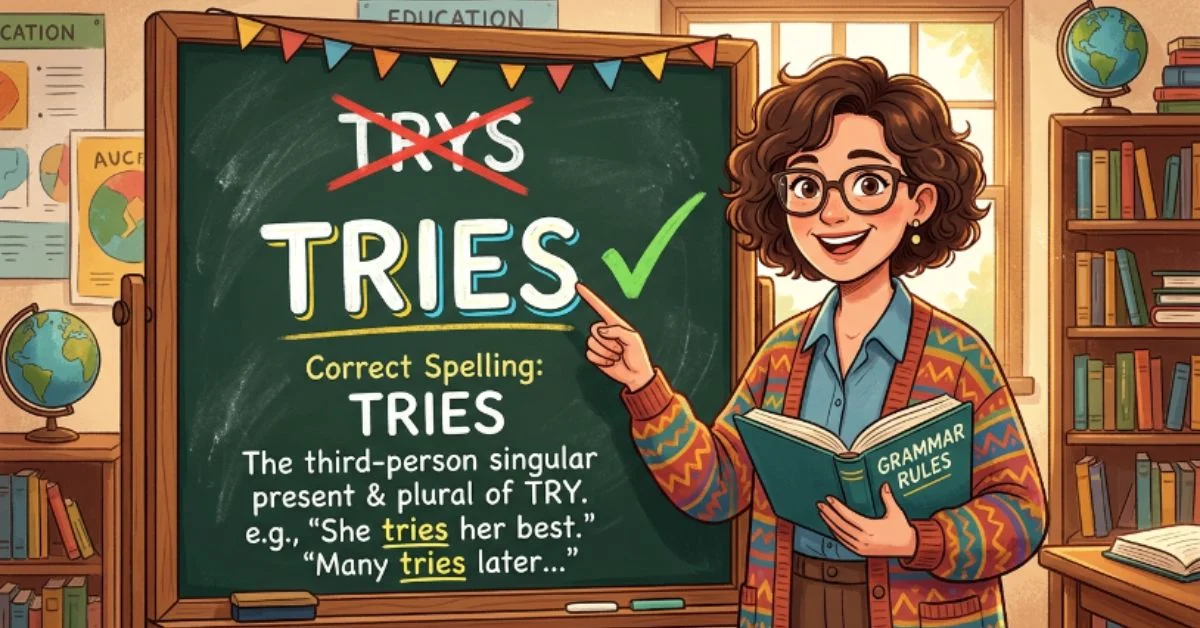
The correct spelling is tries.
The spelling trys is incorrect in standard English.
Examples:
- He tries to learn English every day. ✅
- She tries her best in exams. ✅
- He trys to learn English. ❌
The word “tries” comes from the base verb “try” and follows the third person singular rule in English Grammar.
Key rule:
When a verb ends in -y, and the subject is he/she/it, the “y” changes to “ies”.
- try → tries
- carry → carries
- study → studies
This is part of verb conjugation rules in Verb Conjugation.
Pronunciation of Trys or Tries
Correct pronunciation: /traɪz/ (trize)
- “tries” sounds like “trize”
- the “ie” does NOT change pronunciation
- both “try” and “tries” sound very similar in speech
This similarity in pronunciation is one major reason learners mistakenly write “trys”.
According to standard English phonology rules in English Phonology, spelling does not always match sound patterns, especially in verb inflections.
Dictionaries such as Cambridge Dictionary confirm only “tries” as the correct written form.
Why People Confuse Trys or Tries
The confusion comes from several linguistic and cognitive reasons:
1. Sound vs spelling mismatch
Both “try” and “tries” sound almost identical in speech.
2. Incorrect grammar assumption
Many learners assume:
- just add “s” → trys ❌
Instead of:
- change “y” → “ies” → tries ✅
3. Overgeneralization of rules
Words like:
- play → plays
- stay → stays
make learners think “try” should become “trys”, but verbs ending in consonant + y behave differently.
4. Typing habits
Fast writing often produces “trys” due to simplification.
5. Lack of morphology awareness
In English morphology in English Morphology, verb changes depend on structure, not sound.
Easy Trick to Remember Tries
Use this simple memory rule:
👉 “If it ends in consonant + y, change y to ies”
Examples:
- try → tries
- cry → cries
- study → studies
Memory shortcut:
“I cry, he cries — I try, he tries”
This pattern makes it easy to remember without memorizing grammar rules.
Word Origin and Grammar Background
The word “try” comes from Old French “trier”, meaning to test or examine.
Over time, it entered Middle English and became “try”.
The modern plural and third-person form “tries” developed as part of structured verb rules in English grammar.
This transformation follows patterns in Third Person Singular, where verbs adapt based on subject agreement.
The incorrect form “trys” has no historical or grammatical origin and is not recognized in authoritative sources like the Oxford English Dictionary.
British vs American English Usage
Good news: there is no difference between British and American English for this word.
Both use:
- tries ✅
- trys ❌
| Region | Correct Form | Incorrect Form |
|---|---|---|
| British English | tries | trys |
| American English | tries | trys |
| Canadian English | tries | trys |
| Australian English | tries | trys |
Unlike spelling variations such as color/colour, this rule is universal.
Which Spelling Should You Use?
Always use tries in all contexts:
- Academic writing → tries
- Emails → tries
- Exams → tries
- Business writing → tries
- Social media → tries
“Trys” is always marked as incorrect and may reduce credibility in formal communication.
Standard usage in English Language always follows the “tries” form.
Common Mistakes with Trys or Tries
❌ Mistake 1: Adding only “s”
- He trys to help ❌
- He tries to help ✅
❌ Mistake 2: Confusing with regular verbs
- play → plays
- try → tries (different rule)
❌ Mistake 3: Forgetting third-person rule
- She try to study ❌
- She tries to study ✅
❌ Mistake 4: Over-simplifying spelling
English spelling is rule-based, not always phonetic.
Trys or Tries in Everyday English
Emails:
- She tries to complete tasks on time.
- The team tries to improve performance.
News:
- The government tries to reduce inflation.
- The company tries new strategies.
Social media:
- He tries so hard 😅
- She always tries her best 💪
Formal writing:
- The student tries to improve grammar skills.
- The system tries to detect errors automatically.
Trys or Tries – Google Trends & Usage Data
Search patterns show:
- “trys or tries meaning” → high educational intent
- “why is tries correct” → grammar learning queries
- “trys spelling mistake” → correction-based searches
Top countries:
- Pakistan
- India
- USA
- UK
- Philippines
This indicates the keyword is mostly searched for learning and correction purposes, not alternative usage.
The dominant and universally accepted form is “tries”.
Comparison Table: Trys vs Tries
| Feature | Tries | Trys |
|---|---|---|
| Correct spelling | Yes | No |
| Grammar accepted | Yes | No |
| Dictionary valid | Yes | No |
| Exam usage | Yes | No |
| Professional writing | Yes | No |
Only one form is grammatically correct: tries.
Verb Pattern Breakdown (Deep Grammar Insight)
Base verb: try
Third person singular: tries
Past tense: tried
Present participle: trying
This follows structured verb rules in Present Simple Tense.
Key transformation rule:
- y → ies (for consonant + y verbs)
This is one of the most tested grammar rules in English exams.
Real-Life Correction Examples
Incorrect → Correct
- She trys hard → She tries hard
- He trys again → He tries again
- It trys to work → It tries to work
Even small spelling errors can impact clarity and professional impression.
FAQs
1. What is correct: trys or tries?
“Tries” is correct. “Trys” is incorrect.
2. Why do people write trys?
Because they assume verbs just add “s”.
3. Is trys ever correct?
No, never in any form of English.
4. Why does try become tries?
Because verbs ending in consonant + y change “y” to “ies”.
5. Is tries used in UK and US English?
Yes, both use the same spelling.
6. How do I remember the rule?
Think: try → cries → flies → studies → tries.
7. Is tries formal or informal?
It is correct in all writing styles.
Conclusion
The confusion between “trys or tries” is common but easy to fix once you understand the rule. The correct spelling is always “tries”, while “trys” is a spelling mistake in all forms of English.
This rule is part of standard verb conjugation in English grammar and applies universally across British and American English. Understanding how verbs change in English Grammar helps you avoid one of the most frequent writing errors.
By mastering this simple pattern, you improve your writing accuracy, professional communication, and exam performance. Always remember: verbs ending in consonant + y change to “ies”.
Related Posts:
Fortreen or Fourteen – Which One is Correct and Why?
Niece or Neice: What’s the Correct Spelling and Usage (2026 Guide)