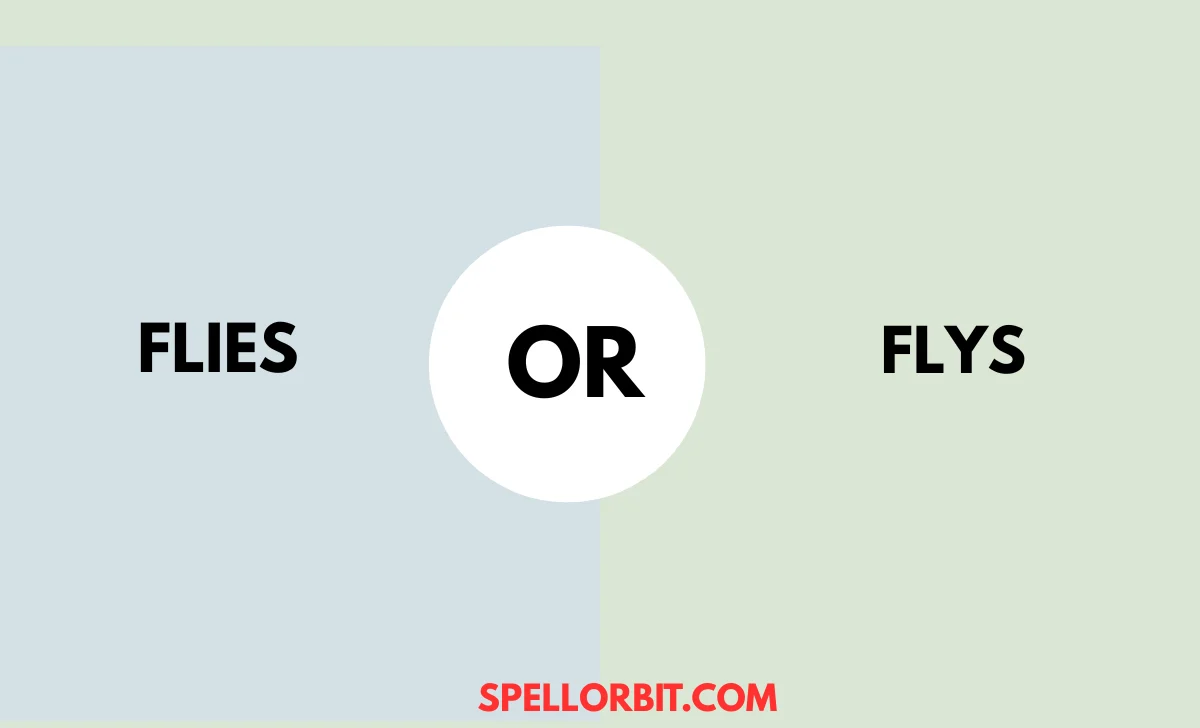
Flies is the correct spelling in standard English, while flys is usually incorrect. The word flies can have two main meanings:
it can be the plural of fly, the insect, or the third-person singular form of the verb fly.
The spelling can be confusing because many English plurals simply add -s, but words ending in consonant + y often change y to ies.
This guide explains why flies is correct, when to use it, and why flys is normally wrong.
You will learn the spelling rule, word history, British and American usage, common mistakes, examples, and easy ways to remember it.
Quick Answer
Flies is the correct spelling in standard English.
Flys is generally incorrect.
The word flies can be:
- The plural of fly, meaning more than one insect.
- The third-person singular form of the verb fly.
Examples:
- There are many flies in the kitchen.
- The bird flies over the trees.
- She flies to London tomorrow.
- Several flies landed on the food.
The basic spelling rule is:
fly → flies
Not:
fly → flys
When a noun or verb ends in a consonant followed by y, the y often changes to i before -es is added.
The Origin of Flies vs Flys
The word fly has very old roots. The noun comes from Old English flēoge, referring to the flying insect. The verb fly also comes from Old English and has long been connected with moving through the air.
Over time, English developed spelling patterns for forming plurals and verb forms.
For a word ending in consonant + y, English commonly changes y to i and adds -es.
For example:
- fly → flies
- cry → cries
- baby → babies
- city → cities
- try → tries
This explains why flies is the standard spelling.
However, if a word ends in a vowel + y, the y usually stays:
- boy → boys
- toy → toys
- day → days
- key → keys
The form flys does not follow the standard spelling rule, so it is not normally accepted as the plural or verb form of fly.
British English vs American English Spelling
British and American English use the same spelling:
flies
Neither variety normally uses flys.
| English Variety | Correct | Incorrect |
|---|---|---|
| British English | flies | flys |
| American English | flies | flys |
| Canadian English | flies | flys |
| Australian English | flies | flys |
| Global English | flies | flys |
Examples:
British English: The plane flies over the city.
American English: The plane flies over the city.
The spelling does not change based on the country.
Which Spelling Should You Use?
Use flies in standard English writing.
For American English
Use flies in schoolwork, emails, reports, websites, and professional documents.
Correct: The airline flies to five cities.
For British English
Use flies in formal and informal writing.
Correct: Several flies were near the window.
For Commonwealth English
Australian, Canadian, and other Commonwealth varieties also use flies.
For Global English
If you are writing for an international audience, always choose flies when you mean the plural of fly or the third-person singular verb form.
Avoid flys in standard writing.
Common Mistakes with Flies vs Flys
Mistake 1: Adding Only -s
Incorrect: There are three flys in the room.
Correct: There are three flies in the room.
Because fly ends in consonant + y, the y changes to i before -es.
Mistake 2: Using Flys as a Verb
Incorrect: The bird flys above the house.
Correct: The bird flies above the house.
The third-person singular form is flies.
Mistake 3: Confusing Flies With Fly’s
Flies can be a plural noun or verb.
Fly’s is a possessive form or a contraction in certain contexts.
Example:
- The fly’s wings are damaged.
- The flies are everywhere.
Mistake 4: Confusing Flies With Fliers
Flies comes from fly.
Fliers usually means people or things that fly or travel by air.
Example:
- The bird flies quickly.
- The airline gave passengers fliers about the new service.
Flies vs Flys in Everyday Examples
In Emails
The plane flies to New York every morning.
Please make sure no flies enter the kitchen.
Both uses are correct.
In News
The airline flies to several international destinations.
Health officials warned residents about an increase in flies.
News writing commonly uses flies as both a verb and plural noun.
On Social Media
Time flies when you’re having fun!
These flies are everywhere today.
The expression time flies is especially common online and in everyday speech.
In Formal Writing
The aircraft flies at a high altitude.
The study examined how flies respond to different conditions.
The spelling remains flies in academic and professional writing.
In Everyday Speech
My sister flies home tomorrow.
There are flies near the window.
The correct form is easy to use once you remember the spelling rule.
Flies vs Flys – Google Trends & Usage Data
Flies has far greater usage than flys because flies is the standard English form.
The word appears in many different contexts:
- Insect-related writing
- Aviation
- Travel
- Biology
- Weather and nature
- Everyday conversation
- Literature
- News
- Academic writing
Searches for flys often come from people checking whether the spelling is correct. The fact that people search for a spelling does not mean it is accepted.
Usage is also consistent across major English-speaking countries. British, American, Canadian, and Australian English all use flies.
Flies vs Flys – Comparison Table
| Word | Correct? | Meaning | Example |
|---|---|---|---|
| flies | Yes | Plural of fly | There are many flies outside. |
| flies | Yes | Third-person form of fly | The bird flies quickly. |
| flys | No | Common misspelling | Avoid this spelling in standard English. |
| fly | Yes | One insect or base verb | A fly landed on the table. |
| fly’s | Yes | Possessive form of fly | The fly’s wings are small. |
| flying | Yes | Present participle | The birds are flying south. |
| flew | Yes | Past tense of fly | The bird flew away. |
| flown | Yes | Past participle | The plane has flown several times. |
Easy Trick to Remember Flies
Use this simple rule:
Consonant + Y → change Y to I and add ES.
So:
fly → flies
You can remember it with:
One fly, two flies.
Another example is:
One baby, two babies.
This helps you see the same spelling pattern.
Do not write:
flys
Write:
flies
When Can a Word Ending in Y Keep the Y?
This is an important spelling rule.
When a word ends in a vowel + y, the y usually stays when forming the plural.
Examples:
- boy → boys
- toy → toys
- day → days
- key → keys
But when a word ends in a consonant + y, the y usually changes to i before -es:
- fly → flies
- city → cities
- story → stories
- party → parties
This rule explains the difference between flies and flys.
FAQs About Flies vs Flys
Is flies the correct spelling?
Yes. Flies is the correct standard spelling for the plural of fly and for the third-person singular form of the verb fly.
Is flys a word?
Flys is not the standard plural or verb form of fly. In normal English writing, use flies instead.
Why does fly become flies?
Because fly ends in consonant + y. The standard spelling changes y to i and adds -es.
Is flies British or American English?
Both British and American English use flies. There is no regional spelling difference.
What is the plural of fly?
The plural of fly, meaning the insect, is flies.
Example: There are several flies in the room.
What is the correct verb form of fly?
For he, she, or it, the correct form is flies.
Example: The bird flies over the lake.
What is the difference between flies and fly’s?
Flies can be a plural noun or a verb. Fly’s is possessive when referring to one fly.
Example:
The flies are outside.
The fly’s wings are damaged.
Conclusion
Flies is the correct spelling, while flys is incorrect in standard English, and the main rule is to change the final y to i and add -es when forming this word.
The easiest practical takeaway is to remember fly → flies, just as baby → babies and city → cities.
This spelling is the same in British, American, Canadian, and Australian English, so there is no regional variation to worry about.
If you are learning other commonly confused English words, you can also read a related guide on “chief vs cheif” to improve your spelling and avoid similar mistakes.
Related Posts
- Chief vs Cheif: in Everyday Sentences?
- Disastrous vs Disasterous: Which Spelling Is Correct?
- Segue vs Segway: What Is the Difference?