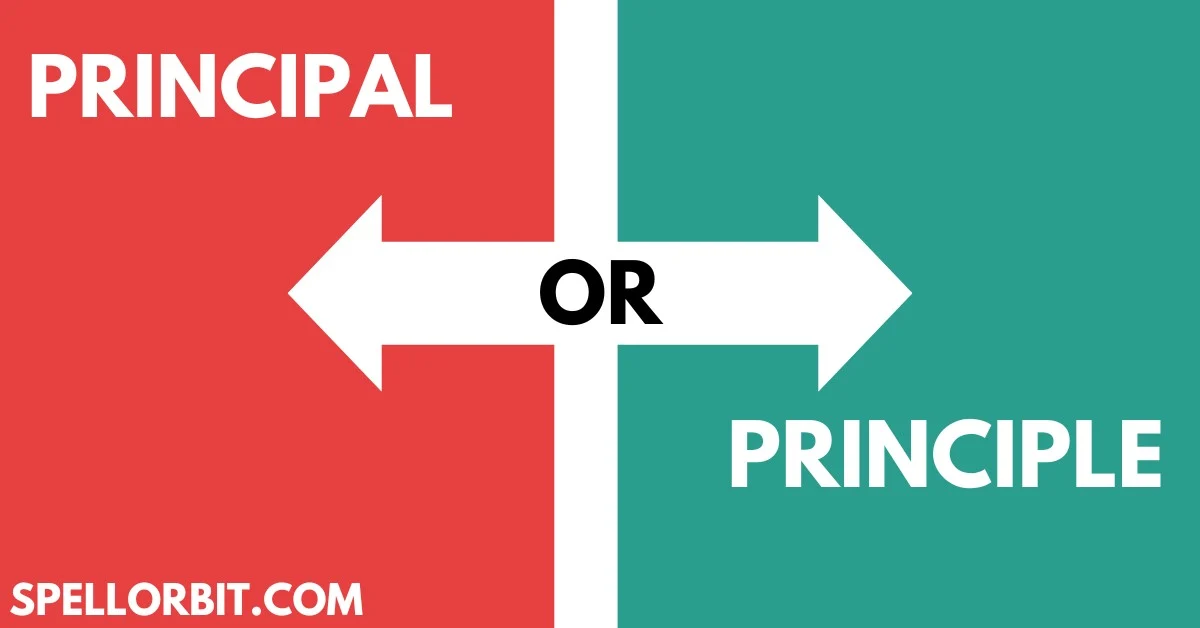
Many English learners struggle with principal vs principle because the two words sound almost identical but have completely different meanings.
Choosing the wrong one can change the meaning of a sentence and make your writing look less professional.
The good news is that the difference is easy to understand once you know what each word means.
This guide explains principal vs principle, their definitions, pronunciation, grammar, examples, memory tricks, and common mistakes so you can use both words correctly with confidence.
Quick Answer
Both principal and principle are correct English words, but they are not interchangeable.
- Principal usually refers to a person (such as a school principal) or means main, primary, or most important.
- Principle refers to a rule, belief, law, or fundamental truth.
Examples
✅ The principal welcomed students on the first day of school.
✅ Honesty is an important principle.
❌ The principle welcomed students. (Incorrect)
❌ Honesty is an important principal. (Incorrect)
Quick Tip: The principal is your “pal.” If you’re talking about a person or the main thing, use principal. If you’re talking about a rule or belief, use principle.
Why Do People Confuse “Principal” and “Principle”?
The confusion exists because the two words are near-homophones. They are pronounced almost the same but have different spellings and meanings.
Several factors contribute to the confusion:
- They differ by only one letter.
- Both are common in academic and professional writing.
- They can both function as nouns.
- Many spell-check tools won’t catch the mistake because both words are correctly spelled.
Understanding the context is the easiest way to choose the correct word.
What Does “Principal” Mean?
The word principal can be used as both a noun and an adjective.
Principal as a Noun
As a noun, principal usually refers to the head of a school or an organization.
Examples
- The principal spoke during the morning assembly.
- Students met the new principal before classes began.
- Our school principal introduced the new teachers.
In education, the principal is responsible for managing the school, supervising teachers, supporting students, and overseeing daily operations.
Principal as an Adjective
As an adjective, principal means main, chief, primary, or most important.
Examples
- The principal reason for the delay was bad weather.
- Water is the principal ingredient in the recipe.
- Safety remains our principal concern.
- The company has two principal offices.
In business, legal writing, and academic papers, principal often describes the most important person, object, or idea.
Principal in Finance
Another common meaning of principal appears in finance.
Here, principal refers to the original amount of money borrowed or invested, excluding interest.
Examples
- We paid part of the loan principal.
- Extra payments reduce the principal balance.
- Interest is calculated based on the outstanding principal.
You may also see terms such as:
- Principal amount
- Principal balance
- Mortgage principal
- Loan principal
- Investment principal
This financial meaning is one of the most searched uses of the word principal.
What Does “Principle” Mean?
Unlike principal, the word principle is always a noun.
It refers to a rule, belief, moral value, basic truth, or fundamental law that guides behavior or explains how something works.
Moral Principles
A moral principle helps people decide what is right or wrong.
Examples
- Honesty is one of my strongest principles.
- She refused to lie because of her personal principles.
- Good leaders act according to ethical principles.
Scientific Principles
In science, a principle explains how something naturally works.
Examples
- The law of gravity is a scientific principle.
- Engineers rely on mathematical principles.
- Physics is built on several fundamental principles.
Legal and Business Principles
The word also appears frequently in law and business.
Examples include:
- Constitutional principles
- Legal principles
- Business principles
- Accounting principles
- Corporate governance principles
Example Sentences
- The company follows sound business principles.
- The court based its decision on constitutional principles.
- Strong ethical principles build trust with customers.
Principal vs Principle: Key Differences
Although these words sound alike, their meanings are completely different.
| Feature | Principal | Principle |
|---|---|---|
| Part of Speech | Noun, Adjective | Noun |
| Main Meaning | Person, chief, primary | Rule, belief, law |
| Education | School principal | ❌ |
| Finance | Loan principal | ❌ |
| Ethics | ❌ | Moral principle |
| Science | ❌ | Scientific principle |
| Business | Principal office | Business principles |
Think About the Context
Ask yourself these questions:
Are you talking about a person, leader, or something main?
→ Use principal.
Are you talking about a rule, value, belief, or law?
→ Use principle.
The context almost always tells you which word is correct.
How to Spell and Pronounce Principal and Principle
Although the two words are spelled differently, their pronunciation is almost identical.
Principal
IPA (American English):
/ˈprɪn.sə.pəl/
Meaning:
- Head of a school
- Main or primary
- Original amount of a loan
Principle
IPA (American English):
/ˈprɪn.sə.pəl/
Meaning:
- Rule
- Belief
- Fundamental truth
- Moral standard
Pronunciation Tip
Since both words sound the same, pronunciation won’t help you choose the correct one.
Instead, focus on the meaning of your sentence.
British English vs American English
One helpful fact is that principal and principle are spelled the same in both American English and British English.
Major dictionaries, including Merriam-Webster, Oxford English Dictionary, Cambridge Dictionary, and Collins Dictionary, recognize the same spellings and meanings.
There are no regional spelling differences between these words.
Whether you’re writing for a university, business, government organization, or international audience, the rules remain the same.
Everyday Examples of Principal and Principle
Seeing these words in context is the easiest way to remember the difference.
Examples of Principal
- The principal congratulated the graduating students.
- Our principal introduced a new attendance policy.
- Her principal responsibility is managing the sales team.
- The principal reason for the meeting was budget planning.
- We paid off part of the loan principal last month.
- The company opened a principal office in Chicago.
- He is the principal investigator on the research project.
Examples of Principle
- Respect is an important principle in every workplace.
- She never compromises her moral principles.
- The experiment is based on a scientific principle.
- Freedom of speech is a constitutional principle.
- Good businesses operate according to ethical principles.
- One basic principle of economics is supply and demand.
- Fairness is a guiding principle of the organization.
Common Mistakes to Avoid
Because principal and principle are near-homophones, writers often choose the wrong word.
Mistake 1: Using “Principle” for a School Leader
❌ The school principle welcomed new students.
✅ The school principal welcomed new students.
Mistake 2: Using “Principal” for a Rule or Belief
❌ Honesty is an important principal.
✅ Honesty is an important principle.
Mistake 3: Confusing the Financial Meaning
❌ I paid extra toward the loan principle.
✅ I paid extra toward the loan principal.
In finance, principal always refers to the original amount borrowed or invested.
Mistake 4: Choosing the Wrong Word in Professional Writing
Before submitting an email, report, essay, or business document, ask yourself:
- Am I talking about a person or the main thing? → Principal
- Am I talking about a rule, belief, or fundamental truth? → Principle
Memory Tricks to Remember the Difference
Simple memory tricks make these words much easier to remember.
The Principal Is Your Pal
The most popular mnemonic is:
The principal is your pal.
Both principal and pal contain -pal, reminding you that a school principal is a person.
Principal Means Main
Think of words like:
- principal office
- principal reason
- principal objective
- principal investigator
Whenever you mean main, chief, or primary, choose principal.
Principle Means Rule
If you’re talking about:
- ethics
- values
- beliefs
- science
- law
- philosophy
the correct word is principle.
Related Words and Synonyms
Synonyms of Principal
When principal means main:
- Main
- Primary
- Chief
- Leading
- Foremost
- Major
- Primary source
When principal refers to a person:
- School head
- Headteacher
- Administrator
- Director
When used in finance:
- Original amount
- Loan balance
- Capital amount
Synonyms of Principle
- Rule
- Belief
- Value
- Standard
- Guideline
- Doctrine
- Philosophy
- Ethics
- Moral code
- Fundamental truth
Choose a synonym only if it fits the context of your sentence.
Similar Commonly Confused Words
If you’re learning English vocabulary, you may also confuse these word pairs:
- Affect vs Effect
- Farther vs Further
- Fewer vs Less
- Advice vs Advise
- Accept vs Except
- Compliment vs Complement
- Stationary vs Stationery
- Ensure vs Insure
- Lay vs Lie
- Than vs Then
Understanding these pairs improves grammar and writing accuracy.
Tips to Use the Correct Word Every Time
Follow these simple tips whenever you write.
Ask Yourself What You Mean
If you mean:
- a school leader
- the chief person
- the main thing
- the original loan amount
Use principal.
If you mean:
- a belief
- a rule
- an ethical value
- a scientific law
Use principle.
Read the Entire Sentence
Instead of focusing on the word alone, read the whole sentence. The surrounding words usually make the correct choice obvious.
Proofread Carefully
Since both words are spelled correctly, grammar and spell-check tools may not detect the mistake.
A quick proofreading check can prevent embarrassing errors in essays, emails, reports, and professional documents.
Google Trends and Usage
Search behavior shows that principal vs principle is one of the most searched grammar questions because both words are valid English words with different meanings.
People commonly search for:
- principal or principle
- difference between principal and principle
- principal meaning
- principle meaning
- school principal or principle
- principal vs principle examples
Educational websites, dictionaries, and grammar guides consistently explain that the correct choice depends entirely on the meaning of your sentence—not pronunciati
FAQs
What is the difference between principal and principle?
Principal refers to a person, something main, or the original amount of a loan. Principle refers to a rule, belief, value, or fundamental truth.
Is it school principal or school principle?
The correct term is school principal.
Which word refers to a moral belief?
Principle refers to moral beliefs and ethical values.
What does principal mean in finance?
It is the original amount of money borrowed or invested before interest.
Are principal and principle pronounced differently?
No. They are pronounced almost identically in both American and British English.
Is principal a noun or an adjective?
It can be both. It is a noun when referring to a school leader and an adjective when meaning main or primary.
Is principle always a noun?
Yes. Principle functions only as a noun.
Final Thoughts
Understanding principal vs principle becomes much easier once you focus on their meanings rather than their pronunciation.
Use principal when referring to a school leader, something main or primary, or the original amount of a loan. Use principle when talking about a rule, belief, ethical value, or fundamental truth.
A simple memory trick can help you avoid mistakes: “The principal is your pal.” If it’s a person or the main thing, choose principal.
If it’s a rule or belief, choose principle. Mastering this commonly confused word pair will make your writing clearer, more accurate, and more professional.
Read More Blogs:
- Keith or Kieth: The Complete Spelling Guide with Examples
- Is It Trouper or Trooper? Here’s the Correct Answer
- Altogether vs All Together: What’s the Difference and Why?
- Trys or Tries: Correct Spelling and Grammar Rules Explained