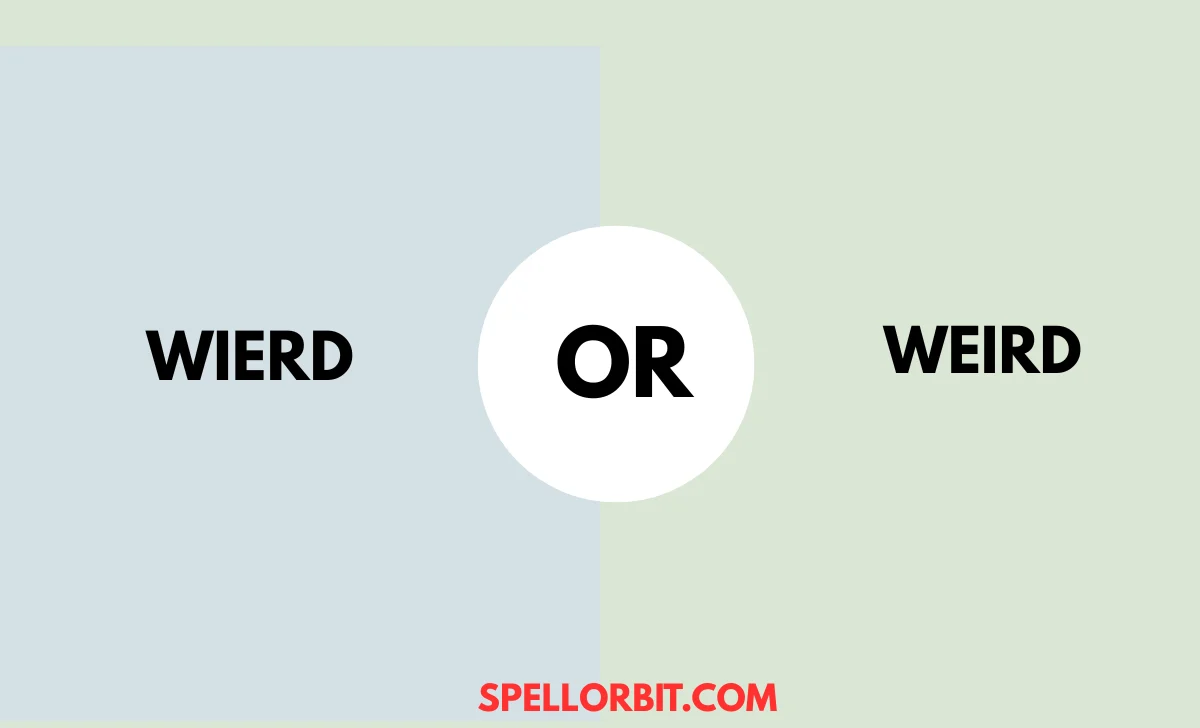
Weird is the correct spelling, while wierd is a common spelling mistake. The word weird means strange, unusual, or different from what is normal.
People often write wierd because they remember the “i before e” rule and place the vowels in the wrong order.
English has many spelling patterns and exceptions, so this mistake is easy to make.
This guide explains the difference between wierd and weird, including their meaning, origin, pronunciation, spelling rules, and everyday use.
You will learn which form to use in British and American English, how to remember the correct spelling, and avoid this common error.
Quick Answer
Weird is the correct spelling.
Wierd is incorrect and should not be used in standard English.
The word weird means strange, unusual, or unexpected.
Examples:
- That was a weird dream.
- She has a weird sense of humor.
- Something weird happened at school.
- This movie has a weird ending.
Wierd vs Weird at a Glance
| Word | Correct? | Meaning |
|---|---|---|
| weird | Yes | Strange or unusual |
| wierd | No | Common misspelling of weird |
The easiest rule is simple: Always spell the word W-E-I-R-D.
The Origin of Wierd or Weird
The word weird comes from Old English wyrd, which was related to fate, destiny, or what happens to a person.
In older English, the word had a strong connection with fate. Over time, its meaning changed. Today, weird usually describes something strange, unusual, or outside what people expect.
The spelling changed as English developed over hundreds of years. Modern English contains many words whose spelling does not follow simple spelling rules. Weird is one of them.
The spelling is also easy to confuse because of the familiar “i before e” rule. People may remember that rule and write wierd instead of weird. However, spelling rules have exceptions, and weird is one of the words that must be learned separately.
British English vs American English Spelling
There is no spelling difference between British English and American English for this word.
Both use weird.
| English variety | Correct spelling | Example |
|---|---|---|
| British English | weird | That is a weird story. |
| American English | weird | That is a weird story. |
| Canadian English | weird | It was a weird experience. |
| Australian English | weird | He had a weird idea. |
This makes weird different from words such as colour/color, favour/favor, and centre/center.
Whether you are writing for readers in the United States, United Kingdom, Canada, or Australia, use weird.
Which Spelling Should You Use?
You should always use weird.
For US English
Use weird in American English.
That was a weird situation.
For UK and Commonwealth English
Use weird in British English and other major Commonwealth varieties.
The weather was weird yesterday.
For Global English
Use weird when writing for an international audience. It is the standard spelling and is widely understood.
Avoid wierd in:
- School assignments
- Academic papers
- Emails
- Business documents
- Blog posts
- News articles
- Resumes
- Professional reports
Common Mistakes with Wierd or Weird
The biggest mistake is reversing the i and e.
Incorrect: That is a wierd idea.
Correct: That is a weird idea.
Another mistake is assuming that “i before e” always works.
Incorrect: Wierd follows the normal spelling rule.
Correct: Weird is one of the common exceptions to that spelling pattern.
Other Common Forms
| Incorrect | Correct |
|---|---|
| wierd | weird |
| wierder | weirder |
| wierdest | weirdest |
| wierdly | weirdly |
Remember that the correct base word is weird. Its related forms keep the same vowel order.
Wierd or Weird in Everyday Examples
In Emails
Correct:
The whole situation was weird, but everything worked out.
An email to a friend can use weird in an informal way. Business emails can also use the word when the meaning is appropriate.
In News
Correct:
Police reported a weird incident near the city center.
News writing should always use the standard spelling weird.
On Social Media
Correct:
That was the weirdest thing I saw today!
Social media is informal, but weird remains the correct spelling.
In Formal Writing
Correct:
The experiment produced a weird result that required further study.
In formal writing, strange or unusual may sometimes sound more professional than weird, but the spelling remains weird.
In Everyday Speech
You might say:
That sounds weird.
Here, weird describes something that seems strange or unusual.
Wierd or Weird – Google Trends & Usage Data
Search interest for weird is much higher than for wierd because weird is the accepted spelling.
The correct word appears in many types of content, including:
- Everyday conversations
- Social media
- Entertainment
- News
- Blogs
- Online searches
- Books
- Academic writing
The misspelling wierd still appears online because many people make the same vowel-order mistake. Search engines can often understand what the user intended and may suggest weird instead.
The word is commonly used across English-speaking countries, including the United States, United Kingdom, Canada, and Australia. Its meaning stays broadly the same across these regions.
For SEO writing, use weird naturally as the main spelling. Mention wierd when explaining the spelling mistake rather than using it repeatedly.
Wierd vs Weird: Comparison Table
| Variation | Status | Meaning | Example |
|---|---|---|---|
| weird | Correct | Strange or unusual | That was a weird dream. |
| wierd | Incorrect | Misspelling | I had a wierd dream. |
| weirder | Correct | More strange | This story is weirder. |
| weirdest | Correct | Most strange | That was the weirdest day. |
| weirdly | Correct | In a strange way | He smiled weirdly. |
Why Do People Spell Weird as Wierd?
The main reason is the order of the vowels.
Many people learn the phrase “i before e” at school. When they hear the word weird, they may automatically put i before e and create wierd.
Pronunciation does not make the spelling obvious either. The sound of weird does not clearly show which vowel should come first.
English also has many spelling exceptions. This means that spelling rules can help, but they cannot always give you the correct answer.
The safest approach is to memorize the spelling:
W-E-I-R-D
Easy Trick to Remember Weird
Use this simple memory trick:
WE starts weird.
The word begins with WE, not WI.
Break it into parts:
WE + IR + D = WEIRD
You can also remember this sentence:
Weird starts with WE.
This makes it easier to avoid writing wierd.
Pronunciation of Weird
Weird is usually pronounced like /wɪrd/ in American English and /wɪəd/ in many British English accents.
It sounds roughly like “weerd.”
The pronunciation can vary slightly by accent, but the spelling remains weird in both British and American English.
FAQS
Is wierd a correct spelling?
No. Wierd is a common misspelling. The correct spelling is weird.
Is weird spelled IE or EI?
Weird is spelled with EI: W-E-I-R-D.
Why is weird often misspelled?
People often reverse the vowels because they remember the common “i before e” spelling rule.
Is weird the same in British and American English?
Yes. Both British and American English use weird.
What does weird mean?
Weird means strange, unusual, unexpected, or different from what is considered normal.
What is the comparative form of weird?
The comparative form is weirder.
Example:
This movie is weirder than the first one.
What is the superlative form of weird?
The superlative form is weirdest.
Example:
That was the weirdest dream I have ever had.
Conclusion
Weird is the correct spelling, and wierd is an incorrect form caused by reversing the vowels. The word means strange, unusual, or unexpected, and its spelling is the same in British and American English.
The best way to remember it is to notice that weird begins with “we,” not “wi.” Use weird in schoolwork, emails, business writing, news, websites, and social media.
If you want to improve your spelling, check each word before publishing and learn common exceptions to basic spelling rules.
For more help, read our related guide on “weird or wierd” and other commonly confused English words correctly.
Related Posts:
- Damnit or Dammit:in Everyday Examples
- Insite or Insight:What Is the Difference Between?
- Excell or Excel: Which Spelling Is Correct?